When you enroll in this course, you'll also be enrolled in this Specialization.
Learn new concepts from industry experts
Gain a foundational understanding of a subject or tool
Develop job-relevant skills with hands-on projects
Earn a shareable career certificate
There are 12 modules in this course
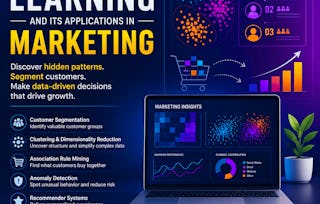
Welcome to the Supervised Learning and Its Applications in Marketing course! Supervised learning is the process of making an algorithm to learn to map an input to a particular output. Supervised learning algorithms can help make predictions for new unseen data. In this course, you will use the Python programming language, which is an effective tool for machine learning applications. You will be introduced to the supervised learning techniques: regression and classification. The course will focus on the applications of these techniques in the domain of marketing.
With the growing amount of data and applications of machine learning in marketing, we can easily find examples of the usage of machine learning in marketing efforts. Companies are starting to use machine learning to better understand customer behaviors and identify different customer segments based on their activity patterns. Many organizations also use machine learning to predict future customer behaviors, such as what items they are likely to purchase, which websites they are likely to visit, and who are likely to churn. With endless use cases of machine learning for marketing, companies of all sizes can benefit from using machine learning for their marketing efforts.
To succeed in this course, you should have a basic understanding of Python.
You will also need certain software requirements, including an Anaconda navigator.
In this module, you will be introduced to the concept and applications of supervised learning with various real-life examples. The module will introduce you to the major challenges faced by marketers in this fast-paced world. You will also learn the introductory concepts of machine learning. Practical applications of supervised learning in marketing, including customer segmentation, churn prediction, recommendation systems, and predictive modeling, will be emphasized through case studies. By the end of the module, you will have the skills to apply supervised learning algorithms effectively in marketing analytics and make data-driven decisions to drive business growth.
Introduction to Machine Learning for Marketing•10 minutes
Concepts for Machine Learning in Marketing•8 minutes
Introduction to Supervised Learning in Marketing •9 minutes
5 readings•Total 55 minutes
Course Overview•10 minutes
Essential Reading: Major Challenges Marketers Face Today•15 minutes
Essential Reading: Introduction to Machine Learning for Marketing•10 minutes
Essential Reading: Concepts for Machine Learning in Marketing•10 minutes
Essential Reading: Introduction to Supervised Learning in Marketing •10 minutes
4 assignments•Total 18 minutes
Major Challenges Marketers Face Today•6 minutes
Introduction to Machine Learning for Marketing•3 minutes
Concepts for Machine Learning in Marketing•6 minutes
Introduction to Supervised Learning in Marketing •3 minutes
1 discussion prompt•Total 20 minutes
Understanding the Applications of Supervised Learning in Marketing •20 minutes
Getting Started With Supervised Learning in Marketing
Module 2•2 hours to complete
Module details
In this module, you will be introduced to some key performance indicators (KPIs) and learn how to visualize these key metrics. You will learn how to compute and build visual plots of these KPIs in Python and how to use machine learning algorithms to understand what drives the successes and failures of marketing campaigns. This module is designed to provide learners with a comprehensive introduction to the fundamental concepts and practical applications of supervised learning in the field of marketing. In this module, learners will explore the basics of supervised learning, including the distinction between labeled and unlabeled data and the process of training and evaluation of supervised learning models. Throughout the module, learners will also gain hands-on experience working with industry-standard tools and platforms, such as Python and scikit-learn, to implement and evaluate supervised learning models. By the end of the module, learners will have the necessary knowledge and skills to apply supervised learning techniques to extract valuable insights from marketing data and make data-driven decisions that drive business growth and success.
What's included
4 videos4 readings4 assignments
Show info about module content
4 videos•Total 41 minutes
Problem Workflow for Supervised Learning and Its Techniques •9 minutes
Key Performance Indicators and Visualizations•11 minutes
Drivers Behind Marketing Engagement•12 minutes
Decision Trees •9 minutes
4 readings•Total 95 minutes
Essential Reading: Problem Workflow for Supervised Learning and Its Techniques •20 minutes
Essential Reading: Key Performance Indicators and Visualizations•30 minutes
Problem Workflow for Supervised Learning and Its Techniques •3 minutes
Key Performance Indicators and Visualizations•3 minutes
Drivers Behind Marketing Engagement•3 minutes
Decision Trees •3 minutes
Weekly Summative Assessment: Supervised Learning in Marketing
Module 3•1 hour to complete
Module details
This assessment is a graded quiz based on the modules covered this week.
What's included
1 assignment
Show info about module content
1 assignment•Total 60 minutes
Graded Quiz: Supervised Learning in Marketing •60 minutes
Deriving Insights from Data
Module 4•2 hours to complete
Module details
In this module, you will dive deeper into the world of decision trees and gain hands-on experience in building and interpreting these powerful models. Through practical exercises and Python programming, you will learn how to construct decision trees from scratch and leverage them to extract valuable insights from marketing data. Additionally, you will explore the significance of product analysis and discover how to uncover crucial analytical components using Python-based tools and techniques. By the end of this module, you will have a comprehensive understanding of decision trees, their application in marketing, and the ability to derive actionable insights from your data-driven analyses. Get ready to sharpen your analytical skills and unlock the potential of decision trees in the realm of marketing.
What's included
4 videos4 readings4 assignments
Show info about module content
4 videos•Total 33 minutes
From Engagement to Conversion •10 minutes
Interpreting Decision Trees•5 minutes
Importance of Product Analytics•5 minutes
Product Analytics Using Python •12 minutes
4 readings•Total 80 minutes
Essential Reading: From Engagement to Conversion•30 minutes
Essential Reading: Importance of Product Analytics •10 minutes
Essential Reading: Product Analytics Using Python •30 minutes
4 assignments•Total 15 minutes
From Engagement to Conversion •6 minutes
Interpreting Decision Trees•3 minutes
Importance of Product Analytics•3 minutes
Product Analytics Using Python •3 minutes
Product Recommender System
Module 5•2 hours to complete
Module details
In this module, you will explore the fascinating world of product recommendation systems. You will learn how these systems leverage machine learning techniques to provide personalized recommendations to customers, enhancing their shopping experience and driving sales. You will understand the different types of recommendation algorithms, such as collaborative filtering and content-based filtering, and how they can be implemented using Python. Through hands-on exercises and real-world examples, you will discover how to collect and analyze customer data, build recommendation models, and evaluate their performance. By the end of this module, you will have the skills and knowledge to develop and deploy effective product recommendation systems, enabling you to target customers with tailored recommendations and improve customer satisfaction and engagement.
Essential Reading: Building Product Recommendation Engine Using Python•15 minutes
Essential Reading: Item-Based Collaborative Filtering and Recommendations •10 minutes
4 assignments•Total 15 minutes
Product Recommender System •3 minutes
Collaborative Filtering •3 minutes
Building Product Recommendation Engine Using Python•6 minutes
Item-Based Collaborative Filtering and Recommendations•3 minutes
1 discussion prompt•Total 30 minutes
Application of Supervised Learning in Product Recommender System•30 minutes
Weekly Summative Assessment: Deriving Insights from Data and Product Recommender System
Module 6•1 hour to complete
Module details
This assessment is a graded quiz based on the modules covered this week.
What's included
1 assignment
Show info about module content
1 assignment•Total 60 minutes
Graded Quiz: Deriving Insights from Data and Product Recommender System •60 minutes
Personalized Marketing
Module 7•3 hours to complete
Module details
In this module, you will delve into the fascinating world of customer analytics and gain valuable insights into how data can be leveraged to understand customer behavior in a marketing context. Through a combination of theory and hands-on practice, you will learn how to apply supervised learning techniques to predict the likelihood of marketing engagement. By analyzing historical customer data and implementing machine learning algorithms in Python, you will discover how to uncover patterns, trends, and hidden insights that can drive effective marketing strategies. The module will also provide practical guidance on implementing customer analytics using Python, enabling you to manipulate, analyze, and visualize data to extract meaningful information. By the end of this module, you will have a solid foundation in customer analytics and be equipped with the skills to make data-driven marketing decisions, enhance customer engagement, and maximize business success.
Essential Reading: Conducting Customer Analytics with Python•25 minutes
Essential Reading: Predictive Analytics in Marketing •15 minutes
Essential Reading: Predicting the Likelihood of Marketing Engagement Using Python•20 minutes
4 assignments•Total 18 minutes
Understanding Customer Behavior •3 minutes
Conducting Customer Analytics with Python •3 minutes
Predictive Analytics in Marketing •9 minutes
Predicting the Likelihood of Marketing Engagement Using Python •3 minutes
1 discussion prompt•Total 30 minutes
Supervised Learning to Personalize Marketing and Build Strategies •30 minutes
Customer Lifetime Value
Module 8•2 hours to complete
Module details
In this module, you will delve into the concept of customer lifetime value (CLV) and its significance in marketing. You will learn how to measure CLV, which involves quantifying the long-term value a customer brings to a business. By understanding CLV, you can make informed decisions regarding customer acquisition, retention, and marketing strategies. Additionally, you will explore machine learning models specifically designed for CLV predictions. You will gain hands-on experience in building and training these models using Python, allowing you to forecast the future value of customers based on their historical data. By the end of the module, you will have a comprehensive understanding of CLV and the skills to develop accurate predictions using machine learning techniques, empowering you to make data-driven decisions to maximize customer value and drive business growth.
Essential Reading: Predicting the Three-Month CLV with Python: Part I •15 minutes
Essential Reading: Predicting the Three-Month CLV with Python: Part II•15 minutes
4 assignments•Total 12 minutes
Customer Lifetime Value •3 minutes
Evaluating Regression Models•3 minutes
Predicting the Three-Month CLV with Python: Part I•3 minutes
Predicting the Three-Month CLV with Python: Part II •3 minutes
1 discussion prompt•Total 30 minutes
Customer Churn Prediction Using Supervised Learning•30 minutes
Weekly Summative Assessment: Personalized Marketing and Customer Lifetime Value
Module 9•1 hour to complete
Module details
This assessment is a graded quiz based on the modules covered this week.
What's included
1 assignment
Show info about module content
1 assignment•Total 60 minutes
Graded Quiz: Personalized Marketing and Customer Lifetime Value•60 minutes
Retaining Customers
Module 10•2 hours to complete
Module details
In this module, you will delve into the topic of customer churn prediction and retention strategies. You will learn how to identify customers who are at risk of churning and implement proactive measures to retain them. Additionally, you will explore the application of artificial neural networks (ANNs) in predicting customer churn. ANNs are powerful machine learning models that can capture complex patterns and relationships in the data. You will gain hands-on experience in building neural network models using Python and leveraging their predictive capabilities to identify customers who are likely to churn. By the end of this module, you will be equipped with the knowledge and tools to analyze customer churn data, develop effective retention strategies, and implement neural network models to predict customer churn in the marketing domain.
What's included
4 videos4 readings4 assignments
Show info about module content
4 videos•Total 32 minutes
Customer Retention •9 minutes
Artificial Neural Networks (ANNs)•9 minutes
Predicting Customer Churn with Python: Part I•8 minutes
Predicting Customer Churn with Python: Part II •7 minutes
Essential Reading: Predicting Customer Churn with Python: Part I•10 minutes
Essential Reading: Predicting Customer Churn with Python: Part II•10 minutes
4 assignments•Total 18 minutes
Customer Retention •9 minutes
Artificial Neural Networks (ANNs)•3 minutes
Predicting Customer Churn with Python: Part I•3 minutes
Predicting Customer Churn with Python: Part II •3 minutes
Deployment of Supervised Learning Models
Module 11•3 hours to complete
Module details
In this module, you will delve into the real-life challenges associated with deploying artificial intelligence (AI) solutions, explore the issues organizations commonly face, and examine the future scope of AI technologies. The module will provide a comprehensive understanding of the practical considerations and obstacles encountered while implementing AI in various industries and sectors. You will explore topics such as data quality and availability, ethical considerations, regulatory compliance, model interpretability, and scalability. Additionally, you will gain insights into the potential impact of AI on the job market, economy, and society as a whole. By the end of the module, you will be equipped with valuable knowledge and perspectives to navigate the complexities of AI deployment, anticipate future trends and challenges, and make informed decisions to drive successful AI initiatives in real-world scenarios.
What's included
4 videos4 readings4 assignments
Show info about module content
4 videos•Total 33 minutes
Real-Life Challenges in Applying Supervised Learning Models •9 minutes
O.P. Jindal Global University is recognised as an Institution of Eminence by the Ministry of Education, Government of India. It is also ranked the No. 1 Private University in India in the QS World University Rankings 2021. The university has 9000+ students across 12 schools that offer 52 degree programs. The university maintains a 1:9 faculty-student ratio.
It is a research-intensive university, deeply committed to institutional values of interdisciplinary and innovative learning, pluralism and rigorous scholarship, globalism, and international engagement.
When will I have access to the lectures and assignments?
To access the course materials, assignments and to earn a Certificate, you will need to purchase the Certificate experience when you enroll in a course. You can try a Free Trial instead, or apply for Financial Aid. The course may offer 'Full Course, No Certificate' instead. This option lets you see all course materials, submit required assessments, and get a final grade. This also means that you will not be able to purchase a Certificate experience.
What will I get if I subscribe to this Specialization?
When you enroll in the course, you get access to all of the courses in the Specialization, and you earn a certificate when you complete the work. Your electronic Certificate will be added to your Accomplishments page - from there, you can print your Certificate or add it to your LinkedIn profile.
Is financial aid available?
Yes. In select learning programs, you can apply for financial aid or a scholarship if you can’t afford the enrollment fee. If fin aid or scholarship is available for your learning program selection, you’ll find a link to apply on the description page.