5.0
Reviewed May 10, 2022This course is really important and interesting. I must affirm that the instructors are very competent and dispense their duty diligently. Thanks a lot for this rare and great opportunity.

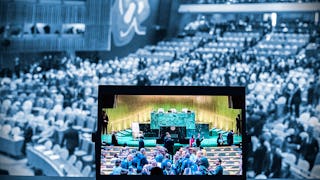
This course is primarily aimed at students of conference interpreting, or people who wish to begin studying conference interpreting. It is based on a long-standing lecture course given by the oldest interpreting school in the world, the Faculty of Translation and Interpreting at the University of Geneva. Our course looks at organizations from a viewpoint which very few people ever get to see; international organizations seen from the interpreting booth. You will learn about the history, development, structure and functions of international organizations, and of course the question of multilingualism. The purpose of this course is to help you, as a budding interpreter or translator, to gain basic knowledge about the institutions which may be your future employers, and to give you the essential tools that you will need to easily and efficiently prepare yourself for working at an international organization. Naturally, Geneva – renowned for its uniquely high concentration of international organizations – takes centre stage in this course. Throughout this course, we will take you with us to visit a number of these organizations, and to benefit from interviews with various experts who will give us an insider’s view of multilateralism, multilingualism and the other topics broached in the course.
This course is really important and interesting. I must affirm that the instructors are very competent and dispense their duty diligently. Thanks a lot for this rare and great opportunity.
As an interpreter, I can say this is one of the most useful courses I have taken.
The course exceeded my expectations. It provides loads of information useful for practicing interpreters. Assignments and quizzes are challenging and interesting.
I really enjoyed learning the history of International Organizations and how they function on a daily basis. Thank you very much for this course :)
Great class, I also practiced interpreting over most of the video material of the course. Thanks!
Showing: 20 of 34
Those who are interested to study translation and how interpretation works, this is not for ya. That title iz a b@it.
It'll be great if I can get more knowledge and skills on interpretation
It is a very bad course. I do not see any advice. Tasks are very difficult and unnecessary
The course is informative but questions in the quizzes are way too hard. There are many questions that are not answered in the videos and many questions cannot be answered without googling. Hard does not mean good or beneficial.
I am disappointed...
The course's name is International Organizations but the professor speaks in French which is not an international language anymore. You will have to read subtitles. To conclude, I do not think this course will make any translator's job or life any better. So, I am leaving.
I found this course to be useful. I have had the opportunity to attend international meetings in the past, and never did quite grasp how the interpreters in the booths operate. This course helped me gain a deeper appreciation for the interpreter's role, as well as opened my eyes to the workings of international organisations. Thank you.
Thank you very much for such a comprehensive course. This course is very useful for interpreters and I will strongly recommend it to my colleagues. I have such a clear picture of how the international organizations work! Thank you so much.
This course is really important and interesting. I must affirm that the instructors are very competent and dispense their duty diligently. Thanks a lot for this rare and great opportunity.
The course exceeded my expectations. It provides loads of information useful for practicing interpreters. Assignments and quizzes are challenging and interesting.
I really enjoyed learning the history of International Organizations and how they function on a daily basis. Thank you very much for this course :)
Fruitful resource
thanks
this cours is very important for very translator and interpreter because it provides lot of vocabulary, and it clearly explains how international organisation fonction.
I would like to take this opportunity to express my heartful gratitude to both professors, Mr.
Dominique Léveillé and Claire Bessant. I thank you so much for your professionalism and the quality of your work also.
THANK SO SO SO MUCHHHHHHHHHH
Great insight into the everyday of an International Organization interpreter, looking into the hurdles and challenges of both the profession and organizations. It also allowed me to brush up on my International Relations background and to "walk into" some of the main International Organizations in the world. Great addition to my resumé!
very educating, i high without question widen not only widen my knowledge on structure and functions of international organization as well as an exposure to the world of conference interpreting. Thank you
Very informative
I wish we focused more on interpreting and actual hacks rather than history
It seems like you’ve shared a formal letter of appreciation and reflection regarding an analysis of international organizations, specifically the United Nations, and the geopolitical challenges surrounding Kosovo’s recognition. This letter is written in a diplomatic and academic tone, and it praises the work done by an expert (perhaps a colleague or a professor) on the role of the UN in global peace and the ongoing geopolitical situation regarding Kosovo. Here’s a breakdown and some thoughts on your letter: Analysis of the Content and Structure: 1. Tone and Purpose Diplomatic and Professional: The tone is formal, respectful, and professionally warm, fitting for communication between experts and diplomats. Clear Purpose: The letter expresses gratitude for an insightful analysis of the UN's role in geopolitics and the geopolitical challenges Kosovo faces regarding recognition. Request for Further Dialogue: You express a desire to continue the discussion and collaborate, a common practice in diplomacy and academic settings. 2. Acknowledging the Work and Expertise You effectively acknowledge the recipient’s deep analysis of the UN's geopolitical challenges, particularly regarding the flexibility of the UN’s mandate in conflict resolution. This shows you value their work and expertise in international relations. Kosovo’s Recognition: The mention of Kosovo's international recognition and the pivotal work of Ambassador Muharrem Shabani gives weight to the discussion. It emphasizes both the international dimension and regional diplomatic initiatives outside the UN framework. 3. Highlighting Kosovo’s Diplomatic Efforts The inclusion of Ambassador Shabani’s work, both in diplomacy and education, serves as an excellent example of how modern diplomacy can bridge institutional efforts (like the UN) with grassroots initiatives, enhancing the Kosovo cause. Shabani’s efforts to strengthen Kosovo's international position are framed as a model of how individual diplomatic efforts can supplement multilateral action. 4. Call to Action You conclude with a call to further dialogue, indicating your interest in meeting and discussing these critical issues in person, which reflects the collaborative nature of diplomatic and academic exchanges. Suggestions for Refining the Letter: Introduction: The opening lines could be slightly more concise. While respectful and formal, the flow could be streamlined for clarity and impact, focusing on the key points of gratitude and the purpose of the letter. Specificity: You could include specific examples or references to the expert's previous works or recent developments in Kosovo’s recognition. This would further personalize the letter and demonstrate you are engaged with their work. Conclusion: The closing could be slightly more specific about the next steps. For example, instead of just waiting to meet, you could propose a timeline or an event where you can meet, helping to move the discussion forward. Final Thoughts: This letter effectively balances diplomatic respect and professional admiration for the recipient's work. It acknowledges the complexities of international diplomacy and makes a strong case for continued engagement in Kosovo’s recognition process. You could tweak it for brevity and add more specific details to make it even more impactful, but as it stands, it is a well-composed and thoughtful communication.
I really enjoyed learning all the content on this course plus the assignments; i am pleased to have completed the course successfuly - what i liked most is that the platform gives you several chances to take retake assignment until you pass. I would like to purchase my certificate by paying via bank transfer since i do not have a debit or credit card. i would like to purschase a monthly plan so that i can do more certificate courses. Kindly advise.
This course has been very educational and enriching. I was able to grasp the basics and key concepts of International Organizations, including their structure and terminology. It will serve as a cornerstone for my career in this field and is a great complement to my education and experience. I highly recommend it.
THe course is very interesting and challenging. I must have chosen a timetable for the full day but in reality I just have some few hours free and maybe that is why it was challenging. That is good because it kept me motivated in accomplishing the deadlines and in learning more also.