When you enroll in this course, you'll also be enrolled in this Specialization.
Learn new concepts from industry experts
Gain a foundational understanding of a subject or tool
Develop job-relevant skills with hands-on projects
Earn a shareable career certificate
There are 5 modules in this course
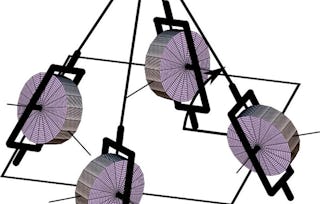
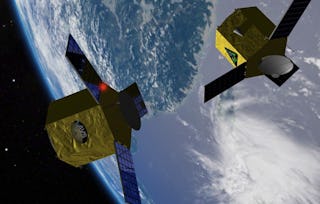
This course is part 1 of the specialization Advanced Spacecraft Dynamics and Control. It is a direct continuation of the Coursera specialization Spacecraft Dynamics and Control. This first course focuses on nonlinear attitude feedback control using a range of angular momentum devices. The course provides a comprehensive review of prerequisite material. Next it develops equations of motion of a spacecraft with momentum exchange devices such as reaction wheels (RWs), control momentum gyroscopes (CMGs) and variable speed control moment gyroscopes (VSCMGs).
The course discusses developing a complex spacecraft simulation with a number VSCMGs and how to approach debugging such complex software. The use of the work/energy theorem is discussed to assist with debugging the simulation by validating angular momentum, energy, changes in momentum and mechanical power.
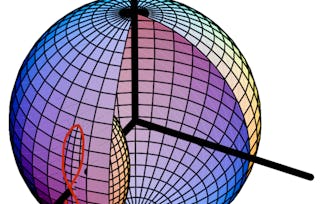
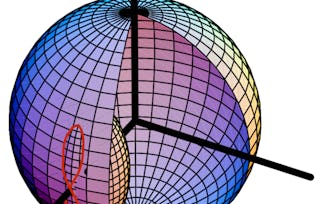
Further, the use of null motion is explored to reconfigure the attitude control devices to avoid singularities and gimbal lock. The redundancy is exploited to seek control solutions that avoid classical CMG singularities.
The material covered is taking from the book "Analytical Mechanics of Space Systems" available at https://arc.aiaa.org/doi/book/10.2514/4.105210.
The prerequisite topics of spacecraft kinematics are reviewed in this module. This sequence is intended to ramp up the student on the mathematical tools and concepts required for this course. For each topic we also dig a little deeper into the subject matter.
Review of fundamental properties of a closed dynamical system leading to the development of the equations of motion.
What's included
7 videos7 assignments
Show info about module content
7 videos•Total 62 minutes
Super Particle Theorem•17 minutes
Kinetic Energy•7 minutes
Momentum of a General System•5 minutes
Rigid Body Rotational Angular Momentum•10 minutes
Inertia Matrix Properties•14 minutes
Rigid Bodies Equations of Motion•4 minutes
Rigid Body Kinetic Energy•5 minutes
7 assignments•Total 140 minutes
Quiz 1 - Super Particle Theorem•15 minutes
Quiz 2 - Kinetic Energy•10 minutes
Quiz 3 - Momentum of a General System•10 minutes
Quiz 4 - Rigid Body Rotational Angular Momentum •15 minutes
Quiz 5 - Inertia Matrix Properties •30 minutes
Quiz 6 - Rigid Bodies Equations of Motion•45 minutes
Quiz 7 - Rigid Body Kinetic Energy•15 minutes
Revisiting the Basics of Nonlinear Spacecraft Control
Module 3•7 hours to complete
Module details
Review of the fundamental nonlinear stability definitions, using Lyapunov's direct method, as well as discussing stability proof modifications if the system is time dependent.
What's included
11 videos9 assignments
Show info about module content
11 videos•Total 158 minutes
Stability Definitions•13 minutes
Stability of a Linearized System•14 minutes
Definite Definitions•14 minutes
Lyapunov Functions•13 minutes
Stability Definitions of Time Dependent Systems•5 minutes
Stability Analysis of Time Dependent Systems•22 minutes
Rigid Body Detumbling•16 minutes
Rigid Body Detumbling (Part 2)•14 minutes
Lyapunov Functions for Attitude Coordinates•8 minutes
3-Axis Attitude Feedback Control•27 minutes
Asymptotic Convergence of Attitude Control•12 minutes
9 assignments•Total 265 minutes
Quiz 1 - Stability Definitions•15 minutes
Quiz 2 - Stability of a Linearized System•30 minutes
Quiz 3 - Definite Definitions•20 minutes
Quiz 4 - Lyapunov Functions•30 minutes
Quiz 5 - Stability and Time Dependent Systems•30 minutes
Quiz 6 - Rigid Body Detumbling•20 minutes
Quiz 7 - Lyapunov Functions for Attitude Coordinates•10 minutes
Quiz 9 - Asymptotic Convergence of Attitude Control•20 minutes
VSCMG Dynamics
Module 4•14 hours to complete
Module details
Develop the kinematics and kinetics of the variable speed CMG devices.
What's included
12 videos10 assignments
Show info about module content
12 videos•Total 139 minutes
Motivation for Studying VSCMG's•19 minutes
VSCMG Coordinate Frames•15 minutes
VSCMG Momentum Vectors•15 minutes
Time Varying Gimbal Frame Vectors•15 minutes
VSCMG Equation of Motion Development•10 minutes
VSCMG Equation of Motion Discussion•17 minutes
RW Motor Torque Equation•14 minutes
CMG Motor Torque Equation•6 minutes
Single RW or CMG Simplification•9 minutes
Spacecraft with Multiple VSCMGs•2 minutes
How to Debug VSCMG Numerical Simulations•9 minutes
Work/Energy Principle for VSCMGs•9 minutes
10 assignments•Total 705 minutes
Quiz 1 - Motivation for Studying VSCMG's •10 minutes
Quiz 2 - VSCMG Coordinate Frames•10 minutes
Quiz 3 - VSCMG Momentum Vectors•45 minutes
Quiz 4 - Time Varying Gimbal Frame Vectors•30 minutes
Quiz 5 - VSCMG Equations of Motion•180 minutes
Quiz 6 - RW Motor Torque Equation•30 minutes
Quiz 7 - CMG Motor Torque Equation•10 minutes
Quiz 8 - Single VSCMG Simulation•240 minutes
Quiz 9 - Spacecraft Simulation with 4 VSCMGs•120 minutes
Quiz 10 - Work/Energy Principle for VSCMGs•30 minutes
Momentum Based 3-Axis Attitude Control
Module 5•16 hours to complete
Module details
Learn how to achieve 3-axis attitude feedback control using a series of momentum exchange devices such as reaction wheels, control moment gyroscopes (CMGs) and variable speed CMGs
CU Boulder is a dynamic community of scholars and learners on one of the most spectacular college campuses in the country. As one of 34 U.S. public institutions in the prestigious Association of American Universities (AAU), we have a proud tradition of academic excellence, with five Nobel laureates and more than 50 members of prestigious academic academies.
I have not complete the first coursera specialization on "Spacecraft Dynamics and Control". Can I jump right into this advanced version?
No, that is not recommended. This course assumes you know the content of the earlier courses and only provides a review of prerequisite material, not an in depth discussion.
When will I have access to the lectures and assignments?
To access the course materials, assignments and to earn a Certificate, you will need to purchase the Certificate experience when you enroll in a course. You can try a Free Trial instead, or apply for Financial Aid. The course may offer 'Full Course, No Certificate' instead. This option lets you see all course materials, submit required assessments, and get a final grade. This also means that you will not be able to purchase a Certificate experience.
What will I get if I subscribe to this Specialization?
When you enroll in the course, you get access to all of the courses in the Specialization, and you earn a certificate when you complete the work. Your electronic Certificate will be added to your Accomplishments page - from there, you can print your Certificate or add it to your LinkedIn profile.
Is financial aid available?
Yes. In select learning programs, you can apply for financial aid or a scholarship if you can’t afford the enrollment fee. If fin aid or scholarship is available for your learning program selection, you’ll find a link to apply on the description page.