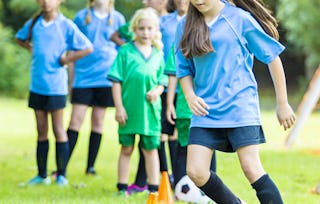
Seventy percent of kids drop out of sports before their high school graduation. Only 15% leave because they feel they are not good enough. Almost 70% leave because they were not having fun, or due to problems with the coach. Injuries cause 30% to give up sports. This course is packed full of practical sports science information that provide youth coaches and parents with the practical pediatric sports science insights to successfully retain young athletes and develop their sport potential while avoiding injury and overtraining. We begin by examining the multidimensional nature of coaching, the relevant sport motor performance abilities, the impact of growth and development on motor skills, the gene versus practice controversy, and briefly overview the body structures strengthened through training. Then we explore the athlete's energy supply, where this energy comes from, and how it matures along with the athlete. Finally, we examine the development of strength, power, anaerobic capacity, coordination and flexibility through the life span.
The optional text manual for this course is available at: http://www.learnitez.com/HighPerformanceScience/manuals/
Youth coaches who have a sound understanding of pediatric sports science are essential to the successful development of a young athlete’s sport potential. In this section you are introduced to the multidimensional nature of coaching, and how an athlete’s motor abilities of endurance, strength, speed, coordination and flexibility are affected by growth and maturation. The manual is available in the Resource Section.
What's included
23 videos3 assignments2 discussion prompts
Show info about module content
23 videos•Total 105 minutes
Course Introduction•4 minutes
Part 1 - Introduction to high performance coaching•4 minutes
Part 2 - How many kids play sports?•7 minutes
Part 3 - Why do kids play sports?•5 minutes
Part 4 - How we gain knowledge•4 minutes
Part 5 - The performance components•6 minutes
Part 6 - The competitive performance•4 minutes
Part 7- Key points of high performance coaching•3 minutes
Part 1 - Introduction to motor performance abilities•6 minutes
Part 2 - Designing physical work capacity•5 minutes
Part 3 - Five components of motor performance•5 minutes
Part 4a - Sport-specific motor abilities•3 minutes
Part 4b - Sport-specific motor abilities•3 minutes
Part 4c - Sport-specific motor abilities•5 minutes
Part 5 - Key points of motor performance abilities•3 minutes
Part 1 - Introduction to growth and maturation•6 minutes
Part 2 - Growth vs. maturation•6 minutes
Part 3 - Gender and puberty•4 minutes
Neurological Development•5 minutes
Thermoregulation and Cardiovascular•4 minutes
Ventilation•3 minutes
Part 5- Key points of growth and maturation•3 minutes
Additional Insights: Educational Opportunities of Sport Organizations (Terry Crawford)•9 minutes
3 assignments•Total 90 minutes
Quiz 1•30 minutes
Quiz 2•30 minutes
Quiz 3•30 minutes
2 discussion prompts•Total 20 minutes
Introduce Yourself•10 minutes
Week 1 Discussion•10 minutes
Week 2: Strategies for maximizing the athlete’s potential
Module 2•4 hours to complete
Module details
Many factors can positively and negatively impact the young athlete’s ability to optimize their sports potential. In this section we examine strategies for ensuring the athlete’s systematic long-term sports development and how to mold the correct sport-specific phenotype.
What's included
20 videos3 assignments1 discussion prompt
Show info about module content
20 videos•Total 113 minutes
Part 1 - Introduction to critical training periods•2 minutes
Part 2 - Ontogeny•8 minutes
Part 3 - Development and environment•7 minutes
Part 4 - Motor circuitry development•6 minutes
Part 5 - Periods of accelerated growth•7 minutes
Part 6 - Key points of critical training periods•4 minutes
Part 1 - Introduction to long term athlete development•3 minutes
Part 2 - Four implicit principles•7 minutes
Part 3 - Physical literacy•10 minutes
Part 4 - Training approaches•6 minutes
Part 5 - Key points of long term athlete development•3 minutes
Dr. Mike Sagas Introduction•3 minutes
Sampling•8 minutes
Benefits of early sampling•5 minutes
What is deliberate play?•5 minutes
Part 1 - Introduction to factors affecting potential•7 minutes
Part 2 - Genotype vs. phenotype•6 minutes
Part 3 - Genetic ceiling effect•6 minutes
Part 4 - Why the body's systems adapt•7 minutes
Part 5 - Key points of factors affecting potential•4 minutes
3 assignments•Total 90 minutes
Quiz 4•30 minutes
Quiz 5•30 minutes
Quiz 6•30 minutes
1 discussion prompt•Total 10 minutes
Week 2 Discussion•10 minutes
Week 3: How the body works
Module 3•3 hours to complete
Module details
The coach is a microbiologist who designs training so it stimulates the body’s cells and structures to become stronger and more efficient. In this section you are introduced to key organ systems, and the energy these organ systems use to run the chemical reactions needed for a sports performance. You will also learn how diet can positively enhance an athlete’s ability to train and compete.
What's included
18 videos3 assignments1 discussion prompt
Show info about module content
18 videos•Total 81 minutes
Part 1 - Introduction to important body structures•5 minutes
Part 2 - Skeletal and muscular system•7 minutes
Part 3 - Nervous system•5 minutes
Part 4 - Respiratory system•5 minutes
Part 5 - Cardiovascular system•2 minutes
Part 6 - Key points of important body structures•2 minutes
Part 1 - Introduction to energy supply•4 minutes
Part 2 - ATP structure and recharging•6 minutes
Part 3 - Creatine phosphate (CP) mechanism•4 minutes
Part 4 - Fast glycolysis•5 minutes
Part 5 - Aerobic energy system•4 minutes
Part 6 - How mitochondria work•7 minutes
Part 7 - Key points of energy supply•3 minutes
Part 1 - Introduction to energy system fuels and diet•5 minutes
Part 2 - Nutrient processing•6 minutes
Part 3 - Role of vitamins and minerals•7 minutes
Part 4 - Nutritional concerns•3 minutes
Part 5 - Key points of energy system fuels and diet•2 minutes
3 assignments•Total 90 minutes
Quiz 7•30 minutes
Quiz 8•30 minutes
Quiz 9•30 minutes
1 discussion prompt•Total 10 minutes
Week 3 Discussion•10 minutes
Week 4: Enhancing the athlete’s physical work capacity
Module 4•6 hours to complete
Module details
The level of expertise with which an athlete is able to perform sports skill depends on how well the coach molds the correct ratio of endurance, strength, power and speed to meet the demands of the sport. In this section you will learn the science behind developing these important motor performance abilities as the young athlete moves through puberty.
Part 1 - Introduction to aerobic capacity•5 minutes
Part 2 - The VO2max test•6 minutes
Part 3 - Comparing the VO2max of athletes•6 minutes
Part 4 - Aerobic capacity of young athletes•5 minutes
Part 5 - Relative VO2max of trained vs untrained children•6 minutes
Part 6 - The child's economy•4 minutes
Part 7 - Key points of aerobic capacity•3 minutes
Part 1- Introduction to strength•3 minutes
Part 2 - Gender strength differences•8 minutes
Part 3 - Trainability of strength•4 minutes
Part 4 - Strength adaptation and training safety•7 minutes
Part 5 - Key points of strength•2 minutes
Part 1 - Introduction to the physiology of strength and power•6 minutes
Part 2 - Muscle components affecting strength and power•5 minutes
Part 3 - Intrinsic sensors•8 minutes
Part 4 - Stretch-shortening cycle•7 minutes
Part 5 - Strength and muscle fiber type•5 minutes
Part 6 - Key points of the physiology of strength•2 minutes
Part 1 - Introduction to anaerobic capacity•4 minutes
Part 2 - Effect of gender and age•7 minutes
Part 3 - Explaining development of anaerobic performance•7 minutes
Part 4 - Sport performance insights•3 minutes
Part 5 - Key points of anaerobic capacity•1 minute
4 assignments•Total 120 minutes
Quiz 10•30 minutes
Quiz 11•30 minutes
Quiz 12•30 minutes
Quiz 13•30 minutes
1 peer review•Total 120 minutes
Coaching Issues•120 minutes
1 discussion prompt•Total 10 minutes
Week 4 Discussion•10 minutes
Week 5: Enhancing the fluidity of movement
Module 5•4 hours to complete
Module details
Coordination and flexibility permit movements that are precise, fluid and spatially controlled. In this section we examine current knowledge about coordination and flexibility as the young child moves through early childhood and into adolescence.
What's included
21 videos2 assignments1 discussion prompt
Show info about module content
21 videos•Total 150 minutes
Part 1 - Introduction to coordination•4 minutes
Part 2 - Brain motor control areas•4 minutes
Part 3 - Coordinating variables•6 minutes
Part 4 - Optimal sequential timing•7 minutes
Part 5 - Soccer example of coordination & control•5 minutes
Part 6 - Learning control•3 minutes
Part 7 - Key points of coordination•2 minutes
Part 1 - Introduction to flexibility•5 minutes
Part 2 - Range of motion strategies•5 minutes
Part 3 - Children and flexibility•2 minutes
Part 4 - Varieties of stretching•8 minutes
Part 5 - Effect of stretching on a muscle•3 minutes
Part 6 - Position statement•2 minutes
Part 7 - Key points of flexibility•2 minutes
Psychology 1 - Acquiring expertise (Dr. Mark Williams)•19 minutes
Psychology 2 - Talent identification and development (Dr. Mark Williams)•20 minutes
Psychology 3 - Perceptual and Cognitive Expertise (Dr. Mark Williams)•21 minutes
Dean Reid Introduction•3 minutes
Dr. Mike Sagas: Sports Management Overview•8 minutes
The University of Florida (UF) is recognized nationally and internationally as a leader in academic excellence, both on campus and online. Ranked in the top 10 of Public Universities, the University of Florida is the state’s oldest university and has a long established tradition of academic excellence.
"To be able to take courses at my own pace and rhythm has been an amazing experience. I can learn whenever it fits my schedule and mood."
Jennifer J.
Learner since 2020
"I directly applied the concepts and skills I learned from my courses to an exciting new project at work."
Larry W.
Learner since 2021
"When I need courses on topics that my university doesn't offer, Coursera is one of the best places to go."
Chaitanya A.
"Learning isn't just about being better at your job: it's so much more than that. Coursera allows me to learn without limits."
Learner reviews
4.8
986 reviews
5 stars
88.14%
4 stars
9.82%
3 stars
1.21%
2 stars
0.20%
1 star
0.60%
Showing 3 of 986
N
NA
5·
Reviewed on Apr 18, 2020
A great thanks to my course instructor Dr Brooks and to my peers,believe me its very rich and would inform many friends to benefits too. keep the spirit and never stop learning.
R
RA
5·
Reviewed on Aug 2, 2020
Very very useful course for any coach anywhere in the world. Many new things learnt. Extremely useful. Thank your coursera for your flexibility and patience.
N
NL
5·
Reviewed on Sep 2, 2020
I found the teachings here very useful for my career path. It helped me understand how to treat kids better when teaching them sport and how to take care of them
When will I have access to the lectures and assignments?
To access the course materials, assignments and to earn a Certificate, you will need to purchase the Certificate experience when you enroll in a course. You can try a Free Trial instead, or apply for Financial Aid. The course may offer 'Full Course, No Certificate' instead. This option lets you see all course materials, submit required assessments, and get a final grade. This also means that you will not be able to purchase a Certificate experience.
What will I get if I purchase the Certificate?
When you purchase a Certificate you get access to all course materials, including graded assignments. Upon completing the course, your electronic Certificate will be added to your Accomplishments page - from there, you can print your Certificate or add it to your LinkedIn profile.
Is financial aid available?
Yes. In select learning programs, you can apply for financial aid or a scholarship if you can’t afford the enrollment fee. If fin aid or scholarship is available for your learning program selection, you’ll find a link to apply on the description page.