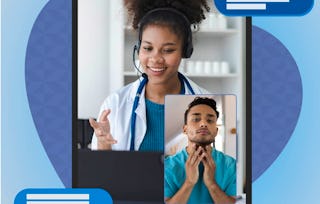
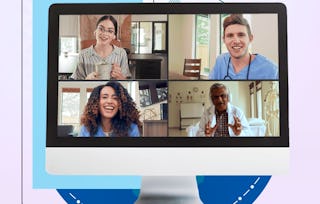
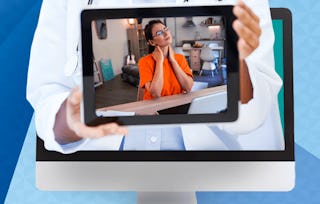
Telehealth uses technology tools such as a cellphone or laptop to give patients and doctors the ability to support healthcare communication and services remotely. The field of telehealth has seen tremendous growth, with telehealth use increasing across all specialties and becoming even more accessible.
This course is designed for healthcare professionals and employees in organizations that practice telehealth or are aspiring to work within the field. As a leading pioneer in the field of telehealth, UC Davis Health began offering telehealth services in 1992 and providing a formal telehealth academic curriculum in 1999.
Go beyond the foundational knowledge of technology tools employed and telehealth applications. Learn about the most effective practices in implementation, regulatory compliance, and how to practice with a health equity lens. With insight from the CEO of UC Davis Health, David Lubarsky, you will leave the course better able to improve your telehealth practice and focus on the elements of telehealth that matter most to your organization and to the patients you serve.
In this module, you will be able to understand the role of telehealth in the healthcare continuum and recognize the three types of telehealth. You will be able to explain the different roles and relationships of the participants in different encounter types. You will be able understand the benefits to the participants in the different encounter types and explain how telehealth can address the six domains of healthcare quality. You will be able to identify who can benefit from telehealth using different perspectives and review common applications of telehealth. You will also be able to explore the return on investment in specific settings.
What's included
8 videos1 reading1 assignment2 discussion prompts
Show info about module content
8 videos•Total 63 minutes
Telehealth Best Practices and Uses Introduction•6 minutes
Technologies•10 minutes
Participants - Part 1•7 minutes
Participants - Part 2•7 minutes
Clinical Applications - Part 1•12 minutes
Clinical Applications - Part 2•7 minutes
Return On Investment (ROI) - Part 1•7 minutes
Return On Investment (ROI) - Part 2•7 minutes
1 reading•Total 10 minutes
A Note From UC Davis•10 minutes
1 assignment•Total 30 minutes
Module 1 Quiz•30 minutes
2 discussion prompts•Total 20 minutes
Learning Goals•10 minutes
Module 1 Reflection•10 minutes
Telehealth: Equity
Module 2•2 hours to complete
Module details
In this module, you'll be able to define health equity and discuss the components of it. You will also be able to define health disparities and discuss the impact of health inequity on health disparities. You will be able to understand the ways in which telehealth is designed to promote health equity and recognize the ways in which it has also promote health equity. You will be able to understand the importance of monitoring the impacts that telehealth technology has on relevant outcomes and understand that although these technologies have potential to promote health equity, we must recognize the ways in which telehealth does not equitably benefit diverse populations. Finally, you will be able to recognize that telehealth equity issues are an understudied area and, as a result, we must be aware of the possible unintended consequences of these tools so that these innovative technologies improve, rather than exacerbate, existing disparities.
What's included
6 videos1 assignment1 discussion prompt
Show info about module content
6 videos•Total 52 minutes
Understanding Health Equity - Part 1•6 minutes
Understanding Health Equity - Part 2•9 minutes
How Health Inequities Create Health Disparities•9 minutes
Promise of Telehealth to Address Inequities•10 minutes
Challenges and Opportunities - Part 1•8 minutes
Challenges and Opportunities - Part 2•9 minutes
1 assignment•Total 30 minutes
Module 2 Quiz•30 minutes
1 discussion prompt•Total 10 minutes
Module 2 Reflection•10 minutes
Telehealth: Best Practices
Module 3•2 hours to complete
Module details
In this module, you will be able to recognize the role of Institutional Culture plays in telemedicine and be able to explore the cultural framework for your organization and establish expectations. You will be able to recognize different telehealth modalities and understand the dynamics of a telehealth visit. You will be able to recognize and apply best practices for a provider during a telehealth visit and be able to standardize the approach to both the physical and virtual office space. You will be able to implement Clinical Practice Guidelines and recognize the steps in the coordination of care. You will be able to prepare for support, explore both the SPIKES and NURSE protocols, and be able to communicate bad news empathetically and effectively.
What's included
8 videos1 assignment1 discussion prompt
Show info about module content
8 videos•Total 70 minutes
Institutional Culture - Part 1•8 minutes
Institutional Culture - Part 2•6 minutes
Provider and Patient Preparation•7 minutes
How To Be an Effective Participant - Part 1•10 minutes
How To Be an Effective Participant - Part 2•9 minutes
Delivering Bad News - Part 1•9 minutes
Delivering Bad News - Part 2•11 minutes
Best Practices•10 minutes
1 assignment•Total 35 minutes
Module 3 Quiz•35 minutes
1 discussion prompt•Total 10 minutes
Module 3 Reflection•10 minutes
Telehealth: Elements of Success
Module 4•2 hours to complete
Module details
In this module, you will be able to recognize the effect of organizational design on a telehealth program. You will be able to determine drivers for program utilization and be able to monitor program using Continuous Quality Improvement (CQI) methods. You will also be able to identify elements of appropriate program management and plan for technical needs of users. You will be able to compare and contrast licensure and credentialing and follow state licensure compacts. You will be able to recognize the different state and federal policies for reimbursement, prescribing, privacy and security as well as be able to explore other laws and regulations that impact telehealth.
What's included
8 videos1 assignment2 discussion prompts
Show info about module content
8 videos•Total 66 minutes
Managing Your Program•7 minutes
Licensure vs. Credentialing - Part 1•10 minutes
Licensure vs. Credentialing - Part 2•6 minutes
Federal vs. State - Part 1•10 minutes
Federal vs. State - Part 2•8 minutes
Following the Rules - Part 1•10 minutes
Following the Rules - Part 2•10 minutes
Course Summary•4 minutes
1 assignment•Total 22 minutes
Module 4 Quiz•22 minutes
2 discussion prompts•Total 20 minutes
Module 4 Reflection•10 minutes
Self-Reflection•10 minutes
Instructor
Instructor ratings
Instructor ratings
We asked all learners to give feedback on our instructors based on the quality of their teaching style.
UC Davis, one of the nation’s top-ranked research universities, is a global leader in agriculture, veterinary medicine, sustainability, environmental and biological sciences, and technology. With four colleges and six professional schools, UC Davis and its students and alumni are known for their academic excellence, meaningful public service and profound international impact.
When will I have access to the lectures and assignments?
To access the course materials, assignments and to earn a Certificate, you will need to purchase the Certificate experience when you enroll in a course. You can try a Free Trial instead, or apply for Financial Aid. The course may offer 'Full Course, No Certificate' instead. This option lets you see all course materials, submit required assessments, and get a final grade. This also means that you will not be able to purchase a Certificate experience.
What will I get if I purchase the Certificate?
When you purchase a Certificate you get access to all course materials, including graded assignments. Upon completing the course, your electronic Certificate will be added to your Accomplishments page - from there, you can print your Certificate or add it to your LinkedIn profile.
Is financial aid available?
Yes. In select learning programs, you can apply for financial aid or a scholarship if you can’t afford the enrollment fee. If fin aid or scholarship is available for your learning program selection, you’ll find a link to apply on the description page.