When you enroll in this course, you'll also be enrolled in this Specialization.
Learn new concepts from industry experts
Gain a foundational understanding of a subject or tool
Develop job-relevant skills with hands-on projects
Earn a shareable career certificate
There are 5 modules in this course
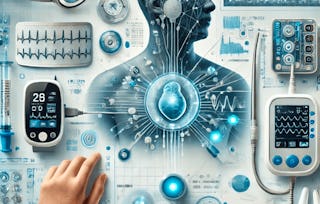
Explore advanced sensor technologies vital to innovative healthcare solutions with our "Sensors and Systems for Biomedical Applications" course. Designed for aspiring professionals in biomedical engineering, healthcare technology, and related fields, this course offers comprehensive knowledge of implantable, diagnostic, and analytical sensor systems.
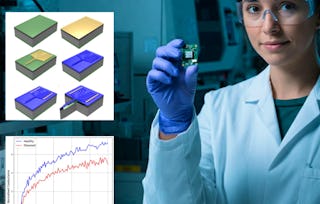
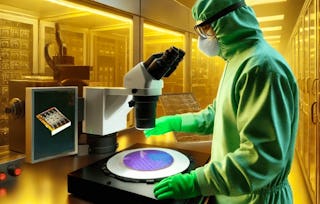
The course encompasses implantable electrodes for neurological conditions such as epilepsy and Parkinson’s disease, material characterisation techniques like IR, UV-Vis, and X-ray spectroscopy, and scanning electron microscopy (SEM). It also includes specialised modules on cancer diagnostic sensors, focusing on breast tissue phenotyping and flexible sensors for detection.
You will gain an understanding of piezoelectric, piezoresistive, temperature, and light-based sensors, including Diffuse Reflectance Spectroscopy and image sensors, and will explore biomedical sensors for glucose, heart rate, ExG, and protein-protein interaction. Additionally, the course highlights the transformative role of artificial intelligence in biomedical applications and provides insights into the regulatory requirements for medical device certification and approval.
This course bridges sensor technology with healthcare applications, preparing you to contribute to innovations in diagnostics, monitoring, and treatment. It equips you with the skills to drive advancements in diagnostics, monitoring, and treatment, making you a valuable asset in the rapidly evolving biomedical field.
Join us to become a leader in healthcare innovation!
Welcome to the second course of the three-part Specialization in Sensor Technologies for Biomedical Applications. In this module, you'll explore implantable electrode technology, focusing on design, fabrication, and material characterization. You will understand neural interfacing principles, tackle long-term implantation challenges, and learn techniques to assess biocompatibility and electrochemical properties.
Welcome to Sensor Technologies for Biomedical Applications Program•2 minutes
About Sensors and Systems for Biomedical Applications•5 minutes
Implantable Electrodes for Epilepsy•43 minutes
Implantable Electrode for Parkinson's Disease•17 minutes
Characterization of Materials: Basics of Infrared (IR) Spectroscopy•39 minutes
Characterization of Materials: Basics of Ultraviolet (UV)-Visible Spectroscopy•36 minutes
Characterization of Materials: Basics of X-Ray Spectroscopy•43 minutes
Introduction to Scanning Electron Microscope (SEM)•42 minutes
5 readings•Total 85 minutes
Course Overview•5 minutes
Course Structure and Critical Information•5 minutes
Meet your Instructor: Prof. Hardik J Pandya•5 minutes
Micro-engineered Devices for Surface and Deep Brain Studies•60 minutes
Additional References: Implantable Devices for Neurological Disorders and Material Characterization•10 minutes
2 assignments•Total 55 minutes
Test Yourself: Implantable Devices and Material Characterization•30 minutes
Let's Practice: Implantable Devices and Material Characterization•25 minutes
2 discussion prompts•Total 20 minutes
Connect with Fellow Learners•10 minutes
Discussion Forum: Implantable Devices for Treating Neurological Disorders•10 minutes
Breast Cancer Diagnosis: From Phenotyping to AI Integration
Module 2•6 hours to complete
Module details
In this module, you will delve into specialized sensors and emerging technologies for biomedical diagnostics, with a focus on breast cancer detection. You will learn to design and apply sensors for ex-vivo breast tissue phenotyping and develop flexible sensors for diagnosis. You'll explore piezoelectric, piezoresistive, and temperature sensors essential for monitoring key parameters. Additionally, you will discover how Artificial Intelligence enhances diagnostic accuracy, optimises sensor data analysis, and enables more personalised healthcare solutions.
Sensor for Phenotyping of Breast Tissues ex-vivo•44 minutes
Flexible Sensor for Breast Cancer Diagnosis•40 minutes
Breast Cancer Diagnosis•38 minutes
Piezoelectric and Piezoresistive Sensor•28 minutes
Temperature Sensors•57 minutes
Introduction to Artifical Intellgence in Biosensors•29 minutes
2 readings•Total 70 minutes
Biosensor for Rapid Breast Cancer Diagnosis•60 minutes
Additional References: Breast Cancer Diagnosis•10 minutes
2 assignments•Total 50 minutes
Test Yourself: Sensors for Cancer Diagnosis•25 minutes
Let's Practice: Sensors for Cancer Diagnosis•25 minutes
1 discussion prompt•Total 10 minutes
Discussion Forum: AI in Medical Diagnostics•10 minutes
From Light to Health: Spectroscopy and Sensor Technologies
Module 3•6 hours to complete
Module details
In this module, you will dive into the fascinating world of optical sensors, starting with the fundamental properties of light and its significance in scientific and medical contexts. You will learn about the principles and applications of Diffuse Reflectance Spectroscopy (DRS) for analyzing biological samples. Additionally, you will explore various light-based sensors such as image sensors, glucose sensors, heart rate sensors, and ExG sensors. This comprehensive study will help you understand the interplay between light and sensor technology, equipping you with the knowledge to apply these concepts in real-world biomedical applications.
Additional References: Glucose and Heart Biosensors•10 minutes
2 assignments•Total 55 minutes
Test Yourself: Spectroscopy and Sensor Technologies•30 minutes
Let's Practice: Spectroscopy and Sensor Technologies•25 minutes
1 discussion prompt•Total 10 minutes
Discussion Forum: Spectroscopy and Sensor Technologies•10 minutes
Biosensors in Healthcare and Medical Device Standards
Module 4•3 hours to complete
Module details
In this module, you will explore advanced biosensors, focusing on protein-protein interactions to understand biological processes and disease mechanisms. Dive into various biosensing technologies, using Sensit Smart to illustrate its features and applications. Learn to integrate biosensors with printed circuit boards (PCBs) and employ multiplexing techniques for simultaneous detection of multiple analytes. This hands-on experience will enhance your understanding of sensor functionality and data interpretation. Finally, we will introduce you to medical device certifications and approvals, providing essential insights into the regulatory requirements for bringing biosensor technologies to market. Prepare yourself for both the technical and compliance aspects of developing biomedical devices.
What's included
5 videos1 reading2 assignments1 discussion prompt
Show info about module content
5 videos•Total 94 minutes
Biosensors for Protein-Protein interaction•61 minutes
Demonstration of biosensor: Sensit Smart•5 minutes
Demonstration of biosensor: Lab on PCB•1 minute
Demonstration of biosensor: Multiplexing on Lab on PCB•1 minute
Introduction to Medical Devices Certifications and Approvals•27 minutes
1 reading•Total 10 minutes
Additional References: Biosensors in Healthcare and Medical Device Standards•10 minutes
2 assignments•Total 50 minutes
Test Yourself: Biosensors in Healthcare and Medical Device Standards•25 minutes
Let's Practice: Biosensors in Healthcare and Medical Device Standards•25 minutes
1 discussion prompt•Total 10 minutes
Discussion Forum: Medical Device Standards for Biosensors•10 minutes
Final Assignment & Course Wrap-Up
Module 5•1 hour to complete
Module details
This culminating module consolidates the knowledge you’ve gained and puts your understanding to the test with a comprehensive final course assignment. Prepare to demonstrate your proficiency and readiness to contribute to groundbreaking innovations in healthcare technology.
What's included
1 video2 readings1 assignment
Show info about module content
1 video•Total 3 minutes
Recap: Sensors and Systems for Biomedical Applications•3 minutes
2 readings•Total 20 minutes
Course Summary•10 minutes
Congratulations & Next Steps•10 minutes
1 assignment•Total 30 minutes
Final Challenge•30 minutes
Earn a career certificate
Add this credential to your LinkedIn profile, resume, or CV. Share it on social media and in your performance review.
Instructor
Instructor ratings
Instructor ratings
We asked all learners to give feedback on our instructors based on the quality of their teaching style.
The Indian Institute of Science is India's premier research institution, globally renowned for its cutting-edge research in science, engineering, and technology, and providing world-class education. Established in 1909, IISc attracts top talent from across the globe and contributes significantly to scientific and technological innovations.
"To be able to take courses at my own pace and rhythm has been an amazing experience. I can learn whenever it fits my schedule and mood."
Jennifer J.
Learner since 2020
"I directly applied the concepts and skills I learned from my courses to an exciting new project at work."
Larry W.
Learner since 2021
"When I need courses on topics that my university doesn't offer, Coursera is one of the best places to go."
Chaitanya A.
"Learning isn't just about being better at your job: it's so much more than that. Coursera allows me to learn without limits."
Learner reviews
4.7
11 reviews
5 stars
72.72%
4 stars
27.27%
3 stars
0%
2 stars
0%
1 star
0%
Showing 3 of 11
A
AS
5·
Reviewed on Feb 18, 2025
clear explanations and useful demonstrations. Perfect for beginners in this field.
A
AB
5·
Reviewed on Feb 18, 2025
This course provides an excellent introduction to biomedical sensors, particularly for medical diagnostics. The coverage of implantable electrodes and cancer detection sensors was fascinating!
M
MN
5·
Reviewed on Feb 19, 2025
This course deepened my understanding of biosensors in medical applications. Great content!
When will I have access to the lectures and assignments?
To access the course materials, assignments and to earn a Certificate, you will need to purchase the Certificate experience when you enroll in a course. You can try a Free Trial instead, or apply for Financial Aid. The course may offer 'Full Course, No Certificate' instead. This option lets you see all course materials, submit required assessments, and get a final grade. This also means that you will not be able to purchase a Certificate experience.
What will I get if I subscribe to this Specialization?
When you enroll in the course, you get access to all of the courses in the Specialization, and you earn a certificate when you complete the work. Your electronic Certificate will be added to your Accomplishments page - from there, you can print your Certificate or add it to your LinkedIn profile.
Is financial aid available?
Yes. In select learning programs, you can apply for financial aid or a scholarship if you can’t afford the enrollment fee. If fin aid or scholarship is available for your learning program selection, you’ll find a link to apply on the description page.