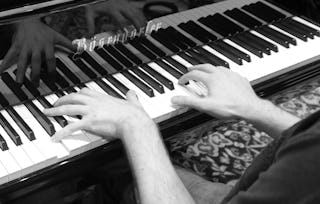
If you have always dreamed of playing the piano or keyboard but did not know where to start, this is the course for you. This course will take you through the fundamental skills necessary to build your playing capability quickly and healthily. In addition to the fundamentals, you will learn from exercises and examples from popular music so that you can start playing in multiple styles. You will start by focusing on posture, breathing, movement, and sound production that will help you strengthen your finger independence and control over dynamics, phrasing, articulation, tempo, and pulse.
At the end of this course, you will have all of the tools necessary to build a dependable piano technique for performing contemporary music. You will be able to identify common chord progressions used in contemporary music and learn how to play both as a soloist and as an ensemble member. Finally, you will be able to improvise over common chord progressions in various contemporary music settings.
Welcome to Piano Techniques for Modern Music! Before you begin the course, we will cover all the details that you'll need to know to get the most out of your experience. Then, we will begin with the fundamentals of healthy piano playing, starting with proper posture and breathing, finger placement and hand position, before moving on to the C major scale and popular cadences. We will begin to build a healthy practice routine and have some fun with improvisation.
The C Major Scale and the I IV V I Cadence•9 minutes
Practice Tips for a Steady and Consistent Practice•4 minutes
Improvisation with a Popular Chord Progression•3 minutes
6 readings•Total 40 minutes
Course Resources •7 minutes
Earn A Course Certificate•5 minutes
Connecting with Your Classmates•5 minutes
Module 1 Definitions •8 minutes
Module 1 Notation•10 minutes
Completing Practice Exercises•5 minutes
2 assignments•Total 60 minutes
Posture and Hand Position•30 minutes
Self-Assessment: Exercise #1•30 minutes
1 peer review•Total 45 minutes
Exercise #1: Posture, Hand Position, and Fundamentals•45 minutes
2 discussion prompts•Total 15 minutes
Meet and Greet•5 minutes
Reflecting on Posture and Hand Position•10 minutes
Module 2: Finger and Arm Technique
Module 2•2 hours to complete
Module details
In module 2, we will start to add greater finger independence to our practice and learn to shift our hands across the keyboard in order to play a wider range of notes with minimal tension in our hands and arms. We will also look at expanding our dynamic range on the piano and applying these techniques to several contemporary music examples.
What's included
6 videos2 readings2 assignments1 peer review
Show info about module content
6 videos•Total 15 minutes
What You'll Learn in Module 2•1 minute
Building Finger Independence•2 minutes
Shifting with the Thumb•4 minutes
Using Your Arms•2 minutes
Practice Tips for Health Playing•5 minutes
Melodic Application of Finger and Arm Technique•1 minute
2 readings•Total 16 minutes
Module 2 Notation•10 minutes
Sign up for the full experience!•6 minutes
2 assignments•Total 60 minutes
Finger and Arm Technique•30 minutes
Self-Assessment: Exercise #2•30 minutes
1 peer review•Total 45 minutes
Exercise #2: Finger and Arm Technique•45 minutes
Module 3: Wrist Technique and Chord Tones
Module 3•3 hours to complete
Module details
In module 3, we will begin to advance our harmonic techniques by expanding our chord knowledge and increasing our playing speed. We will also identify proper wrist technique to minimize tension while playing. We will continue to play through popular tunes and focus on building hand independence.
Melodic Application of the II- V I Progression•1 minute
1 reading•Total 10 minutes
Module 3 Notations•10 minutes
2 assignments•Total 60 minutes
Wrist Technique and Chord Tones•30 minutes
Self-Assessment: Exercise #3•30 minutes
1 peer review•Total 60 minutes
Exercise #3: Wrist Technique and Chord Tones•60 minutes
1 discussion prompt•Total 10 minutes
Wrist Tone vs. Finger Tone•10 minutes
Module 4: Pedal Technique
Module 4•3 hours to complete
Module details
In module 4, we will combine all of the hand techniques we have been developing with pedaling. This will require coordinating our hands and feet. We will practice these techniques using classical music and contemporary tunes. We will also identify what pedaling techniques are common in contemporary music and how to develop virtuosity on the piano. We'll finish by discussing how to organize practice time to learn difficult pieces and why using a practice journal and recording practice session can lead to bigger improvements at a faster rate.
Founded in 2002, Berklee Online is the premier innovator and largest provider of worldwide music education, offering more than 75,000 students from 144 countries the renowned curriculum of Berklee College of Music, at a fraction of the cost. Through Berklee Online’s award-winning online courses, certificates, bachelor’s, and master’s degree programs, students receive expert music instruction and emerge with the skills to exceed the demands of the music industry.
When will I have access to the lectures and assignments?
To access the course materials, assignments and to earn a Certificate, you will need to purchase the Certificate experience when you enroll in a course. You can try a Free Trial instead, or apply for Financial Aid. The course may offer 'Full Course, No Certificate' instead. This option lets you see all course materials, submit required assessments, and get a final grade. This also means that you will not be able to purchase a Certificate experience.
What will I get if I purchase the Certificate?
When you purchase a Certificate you get access to all course materials, including graded assignments. Upon completing the course, your electronic Certificate will be added to your Accomplishments page - from there, you can print your Certificate or add it to your LinkedIn profile.
Is financial aid available?
Yes. In select learning programs, you can apply for financial aid or a scholarship if you can’t afford the enrollment fee. If fin aid or scholarship is available for your learning program selection, you’ll find a link to apply on the description page.