When you enroll in this course, you'll also be enrolled in this Specialization.
Learn new concepts from industry experts
Gain a foundational understanding of a subject or tool
Develop job-relevant skills with hands-on projects
Earn a shareable career certificate
There are 5 modules in this course
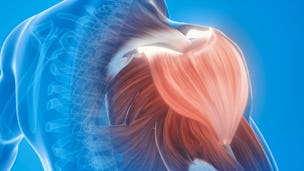
Frozen shoulder can be painful, frustrating, and slow to recover from, often limiting everyday movements such as reaching overhead, dressing, lifting, or sleeping comfortably. By the end of this course, learners will understand the stages of frozen shoulder and how massage and soft-tissue techniques can be adapted to support pain relief, mobility, and recovery through each phase.
Guided by Maureen Abson, LMT, this course explains the pathology of frozen shoulder, including how pain, stiffness, inflammation, and restricted range of motion develop over time. Learners are introduced to a structured, phase-specific approach that helps match treatment goals to the client’s current stage of recovery.
Through studio-filmed demonstrations, learners explore safe positioning, soft-tissue techniques, movement progression, range-of-motion considerations, and client education strategies.
Massage and bodywork professionals will gain practical tools for working with a challenging shoulder condition, while non-clinical learners will better understand why frozen shoulder can take time to improve and how targeted care may support recovery. This course offers a clear, practical framework for managing frozen shoulder with greater confidence and care.
Module 1 provides a clear and practical introduction to frozen shoulder (adhesive capsulitis), followed by hands-on massage strategies designed to reduce pain and improve mobility. The instructor explains what happens inside the shoulder capsule during frozen shoulder, the three clinical phases (freezing, frozen, thawing), common symptoms, and how limitations in movement affect daily life.
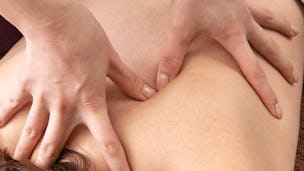
From there, the module moves into step-by-step manual therapy techniques focused on the shoulder, upper back, and surrounding fascia. You’ll learn how to assess tender or restricted areas, how to use slow warming strokes, static pressure, and press-and-release techniques, and how to adapt depth and positioning based on the client’s pain level and phase of recovery. Throughout the instruction, emphasis is placed on client comfort, safe positioning, and working with the shoulder’s current limitations — not forcing movement.
This module provides the foundation for the broader treatment strategy used across the course.
What's included
3 videos2 readings1 assignment1 discussion prompt
Show info about module content
3 videos•Total 26 minutes
Introduction to Treatment•8 minutes
Treating the Shoulder - Part 1•9 minutes
Treating the Shoulder - Part 3•9 minutes
2 readings•Total 15 minutes
Syllabus•5 minutes
Course Workbook•10 minutes
1 assignment•Total 15 minutes
Practice Assignment•15 minutes
1 discussion prompt•Total 10 minutes
Introduction•10 minutes
Treating Frozen Shoulder - Part 2
Module 2•1 hour to complete
Module details
Module 2 demonstrates how head and neck tension can contribute to shoulder dysfunction, pain, and limited movement. The instructor teaches a progression of head, scalp, neck, and jaw massage techniques designed to reduce overall muscle guarding and encourage relaxation of the upper kinetic chain.
You will learn how to work gently around sensitive anatomical structures and avoid high-risk zones such as the carotid artery and anterior neck. Contraindications are covered in detail, including considerations for stroke recovery, dental implants, recent surgery, cosmetic procedures, and jaw tension. The module also teaches techniques for releasing the sternocleidomastoid, levator scapulae, and upper trapezius — muscles that commonly tighten in clients dealing with frozen shoulder or referred pain.
This module reinforces that treating frozen shoulder successfully requires addressing compensatory tension patterns beyond the shoulder itself.
What's included
3 videos1 assignment
Show info about module content
3 videos•Total 30 minutes
Treating the Head and Neck - Part 1•6 minutes
Treating the Head and Neck - Part 2•13 minutes
Treating the Head and Neck - Part 3•11 minutes
1 assignment•Total 15 minutes
Practice Assignment•15 minutes
Treating Frozen Shoulder - Part 3
Module 3•1 hour to complete
Module details
Module 3 focuses on detailed hand and forearm work — an unexpected but powerful approach to improving frozen shoulder symptoms. The instructor explains how fascial continuity and tension patterns in the hand and forearm can directly affect the shoulder, upper back, and neck. The module includes precise, structured hand-massage techniques, working from fingertip to palm to forearm, using rolling, squeezing, line tracking, and static pressure.
Special attention is given to caution points, including pregnancy considerations (avoiding the point between thumb and index finger), arthritis, recent surgery, damaged skin, or active inflammation. The instructor demonstrates how to warm the fingers, avoid painful joints, and follow the fascial tension lines that influence the shoulder.
Therapists will learn how detailed handwork can produce surprisingly immediate improvements in shoulder mobility and pain when treating frozen shoulder.
What's included
3 videos1 assignment
Show info about module content
3 videos•Total 40 minutes
Treating the Hand and Arm - Part 1•7 minutes
Treating the Hand and Arm - Part 2•16 minutes
Treating the Hand and Arm - Part 3•17 minutes
1 assignment•Total 15 minutes
Module Quiz•15 minutes
Reflective Assignments
Module 4•25 minutes to complete
Module details
This module provides an opportunity to consolidate and apply what you’ve learned throughout the course. You will review key concepts, reflect on clinical relevance, and complete a short practice assignment and/or course reflection quiz. The goal is to reinforce understanding and strengthen your ability to integrate these skills into real-world client care.
What's included
1 assignment1 discussion prompt
Show info about module content
1 assignment•Total 15 minutes
Practice Assignment•15 minutes
1 discussion prompt•Total 10 minutes
Introduction•10 minutes
Reflective Learning
Module 5•1 hour to complete
Module details
This final exam is designed to assess your understanding of the key concepts presented throughout the course. Please review all video lessons and written materials before beginning. A passing score of 70% or higher is required to successfully complete the course and earn your CE certificate. You may reference your notes during the exam. Once you pass, your certificate will be available for immediate download.
What's included
1 assignment
Show info about module content
1 assignment•Total 45 minutes
Course Exam•45 minutes
Earn a career certificate
Add this credential to your LinkedIn profile, resume, or CV. Share it on social media and in your performance review.
Niel Asher Education is a world leader in evidence-based online education for massage therapists, manual therapists, and allied health professionals. Our mission is to empower practitioners worldwide with accessible, high-quality training that bridges traditional bodywork, modern rehabilitation, and integrative health science.
When will I have access to the lectures and assignments?
To access the course materials, assignments and to earn a Certificate, you will need to purchase the Certificate experience when you enroll in a course. You can try a Free Trial instead, or apply for Financial Aid. The course may offer 'Full Course, No Certificate' instead. This option lets you see all course materials, submit required assessments, and get a final grade. This also means that you will not be able to purchase a Certificate experience.
What will I get if I subscribe to this Specialization?
When you enroll in the course, you get access to all of the courses in the Specialization, and you earn a certificate when you complete the work. Your electronic Certificate will be added to your Accomplishments page - from there, you can print your Certificate or add it to your LinkedIn profile.
Is financial aid available?
Yes. In select learning programs, you can apply for financial aid or a scholarship if you can’t afford the enrollment fee. If fin aid or scholarship is available for your learning program selection, you’ll find a link to apply on the description page.