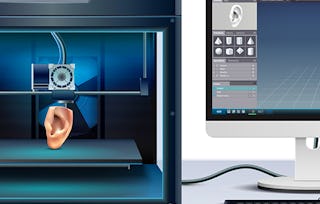
3D printing with metals is revolutionizing manufacturing, engineering, and artistry. In “Introduction to 3D Printing with Metals,” you’ll learn about the essential elements of the technology, and how it can be applied to a range of use cases.
Designed for broad relevance to professionals, hobbyists, and students alike, the course provides essential information about methods of printing using metals, how they work, their advantages and limitations, and most importantly, their practical applications. From basic, desktop forms of 3D printing with metals to more complex processes, like powder bed fusion and jetting-based projects, you will learn about 3D metal printing through examples and interviews with industry experts. You’ll also gain hands-on experience with 3D printing within a smartphone or desktop-accessible augmented reality experience. The content presented in this course draws on a number of interviews with industry experts and was created through a partnership with Siemens.
With this course, you’ll gain a broad understanding of how 3D printing with metals can help you realize your creative vision or enhance your career.
Welcome to the Introduction to 3D Printing with Metals course! Why does one need to 3D print with metals? When is it better to 3D print with metals as opposed to plastic? How is it different? This module will allow you to answer these important questions by reviewing the fundamentals of 3D printing with plastics and introducing the process of 3D printing with metals. Let's start printing!
What Can You Make with Desktop 3D Printing with Metals in Your Context?•15 minutes
Tell us, What Do You Think? •10 minutes
Directed Energy Deposition (DED)
Module 2•4 hours to complete
Module details
Welcome to Module 2! Imagine this: Instead of welding metallic parts together, what if we let the weld be part itself? How to do that? Our imagination can become a reality. Directed Energy Deposition (DED) with metals is a family of processes that allow one to “draw” a part in 3D space by welding together material nonstop until the part is finished. In principle, this would be human-operable, but robotic welders do it because it requires long periods of nonstop operation. This module reviews three types of DED processes, which differ in the size and precision of the machinery used, in the form of the metal stock being welded, and in how the weld is performed. Let's start printing!
What is Wire-Fed DED and How Does it Work?•7 minutes
Advantages and Applications of Wire-Fed DED•7 minutes
Welcome to RAPID+TCT•1 minute
What Parts Can Be Made with Wire-Fed DED? An Interview with MELTIO (Optional)•12 minutes
What Parts Can Be Made with Wire-Fed DED? An Interview with LINCOLN ELECTRIC (Optional)•12 minutes
Limitations of the Wire-Fed DED Process•8 minutes
What is Powder-Fed DED and How Does it Work?•6 minutes
Advantages and Applications of Powder-Fed DED•5 minutes
What Parts Can Be Made with Powder-Fed DED? An Interview with DMG MORI (Optional)•12 minutes
Limitations of the Powder-Fed DED Process•8 minutes
What is Cold Spray and How Does it Work?•5 minutes
Advantages and Applications of Cold Spray•7 minutes
What Parts Can Be Made with Cold Spray? An Interview with SPEED 3D (Optional)•12 minutes
Limitations of the Cold Spray Process•7 minutes
5 readings•Total 50 minutes
What Can you Make with Powder-Fed DED?•15 minutes
⭐Interactive Experience: Prop Housing•10 minutes
⭐Post-Experience Survey Opportunity•5 minutes
Powder-Fed Directed Energy Deposition: Hot vs. Cold•15 minutes
Module 2 Optional Readings & Resources•5 minutes
3 assignments•Total 50 minutes
Knowledge Check: Wire-Fed Directed Energy Deposition•15 minutes
Knowledge Check: Powder-Fed Directed Energy Deposition•15 minutes
Module 2 Quiz: Directed Energy Deposition (DED)•20 minutes
1 app item•Total 15 minutes
⭐Interactive Experience: Prop Housing•15 minutes
2 discussion prompts•Total 25 minutes
What Can You Make with Wire-Fed DED In Your Context?•15 minutes
Tell us, What Do You Think?•10 minutes
Powder Bed Fusion (PBF)
Module 3•3 hours to complete
Module details
Welcome to Module 3! There are many applications for 3D printing with metals that demand extreme precision, far more so than the extrusion-based and welding-based processes—we have learned about so far—can satisfy. A class of processes called Powder Bed Fusion (PBF) addresses this concern by fusing metal powder particles with a far smaller and more concentrated heat source than Directed Energy Deposition (DED), with the powder particles laying stationary as a flat surface to further remove process variability. In this module, we will learn about two types of PBF processes, which differ in the technology used for the heat source. Let's start printing!
What Can You Make with L-PBF In Your Context?•15 minutes
Tell us, What Do You Think?•10 minutes
Jetting-Based Processes
Module 4•3 hours to complete
Module details
Welcome to Module 4! In Module 3, we discussed the powder bed fusion processes and how they produce parts with extreme geometric complexity. However, they are very slow processes. So, what could be done to improve the process speed? A class of methods known as jetting-based processes addresses these concerns by joining powder particles together at room temperature using a glue-like binder and then fusing the joined particles together into a solid part as a post-processing step. This can be done much faster than a continuous application of heat. In this module, we review two types of jetting-based processes, which differ in how the powder particles are joined together during the layer-wise printing process. Let's start printing!
What is Binder Jetting and How Does it Work?•8 minutes
Advantages and Applications of Binder Jetting•7 minutes
What Parts Can Be Made with Binder Jetting? An Interview with Azoth 3D (Optional)•18 minutes
Limitations of the Binder Jetting Process•9 minutes
What is Material Jetting and How Does it Work?•7 minutes
Advantages and Applications of Material Jetting•7 minutes
What Parts Can Be Made with Material Jetting? An Interview with Xjet (Optional)•15 minutes
What Parts Can Be Made with Liquid Metal Jetting? An Interview with ADDITEC (Optional)•8 minutes
Limitations of the Material Jetting Process•7 minutes
4 readings•Total 35 minutes
⭐Interactive Experience: Belt Buckle•10 minutes
⭐Post-Experience Survey Opportunity•5 minutes
What Can You Make with Jetting-Based Processes?•15 minutes
Module 4 Optional Readings & Resources•5 minutes
2 assignments•Total 35 minutes
Knowledge Check: Binder Jetting•15 minutes
Module 4 Quiz: Jetting-Based Processes•20 minutes
1 app item•Total 15 minutes
⭐Interactive Experience: Belt Buckle•15 minutes
2 discussion prompts•Total 25 minutes
What Can You Make with Binder Jetting In Your Context?•15 minutes
Tell us, What Do You Think?•10 minutes
Friction-Lamination Processes
Module 5•3 hours to complete
Module details
Welcome to Module 5, the last Module of the Course! We know already that many applications for 3D printing with metals demand extremely strict quality control. The various fusing methods discussed earlier in the course struggle to meet these demands. Lamination-based processes address this limitation by joining together layers of metal sheets via low-intensity methods that almost exactly reproduce the properties of traditionally wrought material without needing extra post-processing work. In this module, we review two types of jetting-based processes, which differ in the technology used to fuse the metal sheets together. Let's finalize printing!
The mission of the University of Michigan is to serve the people of Michigan and the world through preeminence in creating, communicating, preserving and applying knowledge, art, and academic values, and in developing leaders and citizens who will challenge the present and enrich the future.
When will I have access to the lectures and assignments?
To access the course materials, assignments and to earn a Certificate, you will need to purchase the Certificate experience when you enroll in a course. You can try a Free Trial instead, or apply for Financial Aid. The course may offer 'Full Course, No Certificate' instead. This option lets you see all course materials, submit required assessments, and get a final grade. This also means that you will not be able to purchase a Certificate experience.
What will I get if I purchase the Certificate?
When you purchase a Certificate you get access to all course materials, including graded assignments. Upon completing the course, your electronic Certificate will be added to your Accomplishments page - from there, you can print your Certificate or add it to your LinkedIn profile.
Is financial aid available?
Yes. In select learning programs, you can apply for financial aid or a scholarship if you can’t afford the enrollment fee. If fin aid or scholarship is available for your learning program selection, you’ll find a link to apply on the description page.