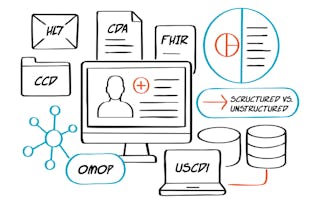
This course is the continuation of the Health Informatics for Healthcare Professionals course. If you have not yet taken the introductory course, it is recommend that you complete that course prior to this course. The foundational knowledge from the introduction is carried through in this deeper dive into informatics in healthcare.
In this course, you will have an opportunity to explore concepts and topics related to the design and management of health information systems. This course covers cybersecurity, privacy, risk mitigation, data blocking, and the role of health information exchanges. It provides an overview of IT budgeting best practices. It also distinguish between pipeline and platform thinking in healthcare information technology and describes healthcare systems’ approaches to creating digital solutions for the future.
Throughout this course, you will be given the opportunity to evaluate your understanding through engagement in course discussions, application of course concepts to course assignments, and through completion of content quizzes along the way.
In this module, the focus will be on the importance of privacy and security in healthcare. Privacy is about respecting patient decisions regarding data usage, access, and purpose, while security is about enforcing those privacy constraints through technology. The module includes case studies and examples of the risks associated with privacy breaches and the importance of enforcing regulations like HIPPA and European regulations to protect patient data while still allowing for innovation in healthcare technology. By the end of this module you will take away lessons in mitigating and preventing security risks to an organization.
Welcome to Healthcare Data Management and Information Systems•2 minutes
Meet your Faculty: Dr. John D. Halamka•2 minutes
Syllabus•10 minutes
Assignment Preview•1 minute
Resource•4 minutes
Resources•8 minutes
Summary•2 minutes
Resource•5 minutes
7 assignments•Total 30 minutes
Module Quiz•14 minutes
Honors Quiz•2 minutes
Question to Consider•2 minutes
Check Your Knowledge•2 minutes
Check Your Knowledge•4 minutes
1 peer review•Total 240 minutes
Identifying and Mitigating Security Risks•240 minutes
1 discussion prompt•Total 20 minutes
Meet Your Fellow Learners•20 minutes
Assessing IT Effectiveness & Spending
Module 2•2 hours to complete
Module details
While learning about various health information systems is important for allowing organizations to improve their clinical outcomes and workflow efficiencies, budgeting is a crucial component to the implementation of new technologies. This module will explore how budgeting occurs for health information systems and how strategic financial planning impacts how organization’s reach goals. You will compare operating and capital expenses and analyze the processes and practices for successful planning of both types of budgets. Finally, you will reflect on how to form successful budgeting teams.
Example Approaches to Planning for Operating Expenses•11 minutes
Capital Expenses•5 minutes
Thoughts on Budgeting Teams•1 minute
2 readings•Total 13 minutes
Resource•11 minutes
Summary•2 minutes
6 assignments•Total 22 minutes
Module Quiz•13 minutes
Question to Consider•1 minute
Check Your Knowledge•2 minutes
Check Your Knowledge•3 minutes
Check Your Knowledge•2 minutes
Check Your Knowledge•1 minute
1 discussion prompt•Total 90 minutes
Evaluating IT Costs•90 minutes
Emerging Technologies & Challenges
Module 3•3 hours to complete
Module details
In the healthcare industry, emerging technologies can be used to greatly improve clinical outcomes and operational efficiencies. However, with these new technologies come may potential risks and challenges that need to be understood and explored prior to implementation. In this module, we will explore the emerging frontier of healthcare technology with emphasis on wearables and home-based care. As we are learning throughout this course, collecting data from many different sources provides a more holistic approach to healthcare. This module will cover more data types such as patient-sourced data and exposome data and how these can help healthcare organizations provide better patient care.
Healthcare Information Technology is facing a digital transformation as we look toward the future of information systems. Organizations are pivoting away from a pipeline approach to a platform approach when implementing organizational strategy and incorporating new innovations. This module will explore these approaches and highlight this shift towards platform thinking through examples from the Mayo Clinic Platform. Finally, this module will conclude discussing the global transformation that is being seen across healthcare systems worldwide and what these changes mean for healthcare as we know it.
What's included
7 videos6 readings6 assignments1 peer review
Show info about module content
7 videos•Total 27 minutes
Module Introduction•1 minute
Overview of Platform Thinking•1 minute
Mayo Clinic and Platform Thinking•8 minutes
Hospitals as Data Science Labs•7 minutes
Global Transformation•1 minute
Tech, Policy, and Cultural Revolution•7 minutes
Course Summary•2 minutes
6 readings•Total 37 minutes
Final Assignment Preview•1 minute
An Overview of Mayo Clinic Platform•6 minutes
Resources•21 minutes
Resource•5 minutes
Summary•1 minute
Congratulations•3 minutes
6 assignments•Total 19 minutes
Module Quiz•10 minutes
Question to Consider•2 minutes
Check Your Knowledge•1 minute
Check Your Knowledge•2 minutes
Check Your Knowledge
•2 minutes
1 peer review•Total 180 minutes
Final Presentation •180 minutes
Instructor
Instructor ratings
Instructor ratings
We asked all learners to give feedback on our instructors based on the quality of their teaching style.
Founded in 1898, Northeastern is a global research university with a distinctive, experience-driven approach to education and discovery. The university is a leader in experiential learning, powered by the world’s most far-reaching cooperative education program. The spirit of collaboration guides a use-inspired research enterprise focused on solving global challenges in health, security, and sustainability.
When will I have access to the lectures and assignments?
To access the course materials, assignments and to earn a Certificate, you will need to purchase the Certificate experience when you enroll in a course. You can try a Free Trial instead, or apply for Financial Aid. The course may offer 'Full Course, No Certificate' instead. This option lets you see all course materials, submit required assessments, and get a final grade. This also means that you will not be able to purchase a Certificate experience.
What will I get if I purchase the Certificate?
When you purchase a Certificate you get access to all course materials, including graded assignments. Upon completing the course, your electronic Certificate will be added to your Accomplishments page - from there, you can print your Certificate or add it to your LinkedIn profile.
Is financial aid available?
Yes. In select learning programs, you can apply for financial aid or a scholarship if you can’t afford the enrollment fee. If fin aid or scholarship is available for your learning program selection, you’ll find a link to apply on the description page.