When you enroll in this course, you'll also be enrolled in this Specialization.
Learn new concepts from industry experts
Gain a foundational understanding of a subject or tool
Develop job-relevant skills with hands-on projects
Earn a shareable career certificate
There are 3 modules in this course
This course focuses on assessing health impacts of chemicals in products and of fine particulate emitted along the product life cycle. We first develop the assessment framework to assess exposure and health impacts of chemicals in products. We then detail the application of mass-balance approaches to the case of parabens in personal care products. Participants then learn to assess the human health impacts of chemicals in products using the USEtox model (UN-Environment toxicity model) and discuss the level of protection offered by existing regulations about chemicals in products contrasting US and Europe. We extend the assessment to risks and impacts 5000+ chemical-household product combinations identifying the products and chemicals of concern in e.g. home maintenance and personal care products and looking at children as a sensitive population and at the magnitude of the risks associated with exposures to chemicals in toys. We also introduce a Life Cycle-based approach to Chemical Alternatives Assessment (CAA) combining both quantified exposure and hazards and discuss the applicability domain of CAA compared to Risk Assessment (RA) and Life Cycle Assessment (LCA). We finally determine exposure to and effect of fine particulates on human health along the product and chemical supply chain and life cycle. This course concludes the course series by providing cutting-edge progress on the overall exposome and compares the health impacts of multiple environmental exposures on health.
This course focuses on assessing the health impacts of chemicals in products and of fine particulates emitted along the product life cycle. This week we will develop the assessment framework to assess exposure and health impacts of chemicals in products. Then we detail the application of mass-balance approaches to the case of parabens in personal care products. Participants then learn to assess the human health impacts of chemicals in products using the USEtox model (UN-Environment toxicity model) and discuss the level of protection offered by existing regulations about chemicals in products contrasting US and Europe.
USEtox – The UNEP-SETAC toxicity model The Personal Care Product Interface – Exposures, risks and damages•13 minutes
User input data for the Personal Care Product Interface - USEtox – The UNEP-SETAC toxicity model •6 minutes
[Optional] USEtox transfers and product intake fractions (optional for the general version of USEtox without using product interface)•11 minutes
[Optional]USEtox dose and risks: the Personal Care Product interface (optional for the general version of USEtox without using product interface)•5 minutes
[Optional] USEtox impacts (optional for the general version of USEtox without using product interface)•10 minutes
4 readings•Total 40 minutes
Syllabus•10 minutes
Pre-Course Survey •10 minutes
Week 1 Slides •10 minutes
Download USEtox•10 minutes
8 assignments•Total 165 minutes
Week 1 assessment•30 minutes
Knowledge check 1 - Chemical assessment framework•5 minutes
Knowledge check 2 - Which method for which problem?•5 minutes
Knowledge check 3 - Parabens in Personal Care Products•5 minutes
Activity 1 Heat maps to determine exposures to PCPs•30 minutes
Activity 2: Risks and impacts of hydroquinone in face cream and shampoo•30 minutes
Knowledge check 4: risk and impact metrics•30 minutes
Activity 3: USEtox - hydroquinone in body lotion•30 minutes
2 discussion prompts•Total 20 minutes
Activity 1 Reflection •10 minutes
Activity 2 Reflection •10 minutes
Chemicals of Concern
Module 2•4 hours to complete
Module details
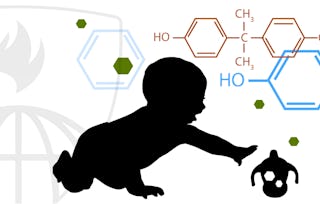
This week we will extend the assessment to risks and impacts 5000+ chemical-household product combinations identifying the products and chemicals of concern in e.g. home maintenance and personal care products and looking at children as a sensitive population and at the magnitude of the risks associated with exposures to chemicals in toys.
Impacts of PCPs - Should we care - PCP in history and regulations•11 minutes
Impacts of chemicals in products - Should we care - PCPs chemicals of concern and mitigation strategies•11 minutes
Impacts and risks of chemicals in household products - Exposure & impacts per chemical-product combination•9 minutes
Impacts and risks of chemicals in household products - Household products and chemicals of concern: impacts•8 minutes
Impacts and risks of chemicals in household products - Household products and chemicals of concern: risks•7 minutes
Chemicals in toys Part A Amounts of chemicals•11 minutes
Chemicals in toys - Part B Exposure•12 minutes
Chemicals in toys - Part C Risks and chemicals of high concern•6 minutes
Risks of chemicals in toys - Mouthing and chemicals of concern in toys and buildings•7 minutes
The Toy Interface - Exposures, risks and damages •13 minutes
1 reading•Total 10 minutes
Week 2 Slides•10 minutes
6 assignments•Total 80 minutes
Week 2 assessment•30 minutes
Knowledge check 5 - Chemicals in PCPs should we care•5 minutes
Knowledge check 6 - Household products•5 minutes
Activity 4 household products and diagonal plots•5 minutes
Knowledge check 7: Plasticizers in toys•5 minutes
Activity 7: Plasticizers in toys•30 minutes
4 discussion prompts•Total 60 minutes
Activity 4 Reflection •10 minutes
Activity 5 Ecosystem impacts of household products•20 minutes
Activity 6: Toy stories in the press•20 minutes
Activity 7 Reflection •10 minutes
Life Cycle Based Chemical Alternatives Assessment and Impacts of Fine particulates
Module 3•6 hours to complete
Module details
This week we will introduce a Life Cycle-based approach to Chemical Alternatives Assessment (CAA) combining both quantified exposure and hazards and discuss the applicability domain of CAA compared to Risk Assessment (RA) and Life Cycle Assessment (LCA). Finally, we will determine exposure to and effect of fine particulates on human health along the product and chemical supply chain and life cycle. This course concludes the course series by providing cutting-edge progress on the overall exposome and compares the health impacts of multiple environmental exposures on health.
The mission of the University of Michigan is to serve the people of Michigan and the world through preeminence in creating, communicating, preserving and applying knowledge, art, and academic values, and in developing leaders and citizens who will challenge the present and enrich the future.
When will I have access to the lectures and assignments?
To access the course materials, assignments and to earn a Certificate, you will need to purchase the Certificate experience when you enroll in a course. You can try a Free Trial instead, or apply for Financial Aid. The course may offer 'Full Course, No Certificate' instead. This option lets you see all course materials, submit required assessments, and get a final grade. This also means that you will not be able to purchase a Certificate experience.
What will I get if I subscribe to this Specialization?
When you enroll in the course, you get access to all of the courses in the Specialization, and you earn a certificate when you complete the work. Your electronic Certificate will be added to your Accomplishments page - from there, you can print your Certificate or add it to your LinkedIn profile.
Is financial aid available?
Yes. In select learning programs, you can apply for financial aid or a scholarship if you can’t afford the enrollment fee. If fin aid or scholarship is available for your learning program selection, you’ll find a link to apply on the description page.