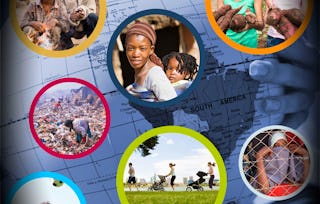
This course will provide you with an overview of the most important health challenges facing the world today. You will gain insight into how challenges have changed over time, we will discuss the likely determinants of such changes and examine future projections. Successful international strategies and programs promoting human health will be highlighted and global health governance structures will be mapped and the role of the key actors explored.
Welcome to the first module of this global health course. In the first lesson we will introduce you to the overall concepts and definitions of global health and examine the question "What are the biggest global health challenges?". You'll get to hear some answers from fellow learners from around the world, and also have an opportunity to join the conversation here in the course discussion forums. We also have an interview with Professor Susan Whyte about the impact of health policy on a population's health. The second lesson deals with the central tools needed to measure global health burden. Together these two lessons will form the basis on which all the other topical modules are built. Enjoy!
What's included
8 videos3 readings1 assignment1 discussion prompt
Show info about module content
8 videos•Total 97 minutes
1.1: Welcome to the Course (F Konradsen)•10 minutes
1.2: Voxpop - What is the biggest global health challenge? (Your fellow students)•2 minutes
1.3: How Changing Policies Impact Population's Health (S Whyte)•16 minutes
2.1: Epidemiological and Demographic Transition (DW Meyrowitsch)•19 minutes
2.2: Disability Adjusted Life Years (DALYs) (DW Meyrowitsch)•9 minutes
2.3: Global Burden of Diseases (DW Meyrowitsch)•20 minutes
2.4: Disease-specific Risk Factors, part 1 (IC Bygbjerg)•10 minutes
2.5: Disease-specific Risk Factors, part 2 (IC Bygbjerg)•12 minutes
3 readings•Total 30 minutes
Course Information•10 minutes
Suggested readings and resources•10 minutes
1 assignment•Total 30 minutes
Defining and Measuring Global Health•30 minutes
1 discussion prompt•Total 10 minutes
What is your opinion?•10 minutes
Infectious Diseases
Module 2•2 hours to complete
Module details
The second module of this course is focussed on infectious diseases. Lesson 3 will introduce you to the concept of infectious diseases and their relation to poverty and development, and lesson 4 will go through three prominent examples of infectious diseases that are still unfinished agendas in large parts of the world.
What's included
5 videos2 readings2 assignments
Show info about module content
5 videos•Total 63 minutes
3.1: Infectious Diseases, part 1 (IC Bygbjerg)•12 minutes
3.2: Infectious Diseases, part 2 (IC Bygbjerg)•8 minutes
4.1: Infectious Diarrheal Diseases (S Tulsani)•13 minutes
4.2: Malaria - The Transition (L Hviid)•15 minutes
4.3: HIV in Global Health (J Lundgren)•15 minutes
2 readings•Total 20 minutes
Suggested readings and resources•10 minutes
2 assignments•Total 60 minutes
Infectious Diseases•30 minutes
Online Activity: Infectious Diseases and Development Goals•30 minutes
Non-Communicable Diseases and Injuries
Module 3•3 hours to complete
Module details
In the third module we'll have a closer look at non-communicable diseases, in short NCDs, and examine the forces that are behind the global epidemic rise of NCDs such as diabetes. The module also includes a lesson about mental health and injuries - two major global health challenges that are often ignored when dealing with NCDs.
What's included
7 videos2 readings3 assignments
Show info about module content
7 videos•Total 91 minutes
5.1: NCDs explained (AR Demaio)•13 minutes
5.2: The Global Burden of Disease - The Rise of NCDs (AR Demaio)•15 minutes
5.3: Determinants and Drivers of NCDs (AR Demaio)•8 minutes
5.4: Diabetes (V Narayan)•18 minutes
5.5: Joint Risk Factors (IC Bygbjerg)•15 minutes
6.1: Mental Health in a Global Perspective (M Muijen)•12 minutes
6.2: Pesticides and Self Harm in Sri Lanka (M Eddleston)•10 minutes
2 readings•Total 20 minutes
Suggested readings and resources•10 minutes
3 assignments•Total 90 minutes
Non-Communicable Diseases and Injuries•30 minutes
Online Activity: Air Pollution•30 minutes
Online Activity: Road Traffic Injuries•30 minutes
Maternal and Child Health
Module 4•3 hours to complete
Module details
This fourth module deals with maternal and child health. The first focus will be on the important, and at times controversial, topic of sexual and reproductive health and rights, often shortened to SRHR. This is followed by a short lesson focussed on child health.
7.1: Sexual and Reproductive Health and Rights (S Tellier)•10 minutes
7.2: Components of Sexual and Reproductive Health (BL Sørensen)•18 minutes
7.3: The Role of the United Nations Population Fund (UNFPA) (E Dupont)•12 minutes
7.4: Abortion Stigma (T Gammeltoft)•9 minutes
8.1: mHealth in Reproductive and Child Health (S Lund)•10 minutes
8.2: Continuum of Care (C Schmiegelow)•10 minutes
3 readings•Total 30 minutes
Suggested readings and resources•10 minutes
Join our challenge: Help us reach the United Nations Sustainable Development Goals (SDGs)!•10 minutes
1 assignment•Total 30 minutes
Maternal and Child Health•30 minutes
4 discussion prompts•Total 55 minutes
UNFPA blog post on access to contraceptives•15 minutes
UNFPA blog post on child marriage•15 minutes
UNFPA blog post on Female Genital Mutilation (FGM)•15 minutes
Share your UNFPA advocacy experience•10 minutes
Environment, Climate and Migration
Module 5•2 hours to complete
Module details
In the fifth module we are looking at some great global crises that profoundly impact the health of populations, namely environment, climate change, and migration. We will examine the health acpect of these mega trends - how are they influencing and challenging policy, health systems, and the health of individuals in both low and high income countries?
What's included
6 videos2 readings1 assignment
Show info about module content
6 videos•Total 77 minutes
9.1: Environmental Health Challenges (F Konradsen)•16 minutes
9.2: Main Environmental Challenges (R Bos)•14 minutes
9.3: Climate Change and Health (P Furu)•18 minutes
10.1: Refugees and Internally Displaced (S Tellier)•10 minutes
10.2: Migrants and Health (S Tellier)•11 minutes
10.3: Migration and Health in a Scandinavian Context (M Nørredam)•9 minutes
2 readings•Total 20 minutes
Suggested readings and resources•10 minutes
1 assignment•Total 30 minutes
Environment, Climate and Migration•30 minutes
Food and Water
Module 6•2 hours to complete
Module details
Access to nutrituous food and clean water are fundamental to health and wellbeing. In the sixth module we are focussing on the role of nutrition and water, with some extra attention to the important role of sanitation and hygiene and their relation to human development.
What's included
4 videos2 readings2 assignments
Show info about module content
4 videos•Total 50 minutes
11.1: Nutrition and Infectious Diseases (H Friis)•15 minutes
11.2: Diabetes and Maternal and Child Health (KK Nielsen)•6 minutes
12.1: Sanitation and Development Goals (S Cairncross)•14 minutes
12.2: Diseases Related to Water, Sanitation and Hygiene (W van Der Hoek)•15 minutes
In this final module of the course we will go full circle, with lessons about the role of health systems and the impact of policy. The last lesson of the course will focus on global health governance and the health aspects of the UN Sustainable Development Goals.
What's included
7 videos5 readings2 assignments
Show info about module content
7 videos•Total 93 minutes
13.1: NCDs and Health Care Systems (G Galea)•12 minutes
13.2: Financing Universal Health Coverage (A Bjerrum)•15 minutes
13.3: Health Care Facilities in Burkina Faso (H Samuelsen)•9 minutes
13.4: Health Systems in Fragile States (TA Dræbel)•22 minutes
13.5 Medical Tourism•17 minutes
14.1: Global Health Governance (S Tellier)•9 minutes
14.2: Framework Convention on Tobacco Control (K Mauer-Stender)•9 minutes
5 readings•Total 50 minutes
Suggested readings and resources•10 minutes
Keep in touch•10 minutes
Learning More•10 minutes
Lecturers•10 minutes
2 assignments•Total 60 minutes
Health Systems and Global Health Governance•30 minutes
Online Activity: Framework for Health Systems•30 minutes
Instructor
Instructor ratings
Instructor ratings
We asked all learners to give feedback on our instructors based on the quality of their teaching style.
The University of Copenhagen is the oldest University in Denmark; founded in 1479, and with over 38,000 students and more than 9,000 employees. The purpose of the University is to conduct research and provide education to the highest academic level. Based in Denmark's capital city it is one of the top research institutions in Europe.
"To be able to take courses at my own pace and rhythm has been an amazing experience. I can learn whenever it fits my schedule and mood."
Jennifer J.
Learner since 2020
"I directly applied the concepts and skills I learned from my courses to an exciting new project at work."
Larry W.
Learner since 2021
"When I need courses on topics that my university doesn't offer, Coursera is one of the best places to go."
Chaitanya A.
"Learning isn't just about being better at your job: it's so much more than that. Coursera allows me to learn without limits."
Learner reviews
4.8
885 reviews
5 stars
81.46%
4 stars
16.49%
3 stars
1.58%
2 stars
0.11%
1 star
0.33%
Showing 3 of 885
A
AK
5·
Reviewed on Jun 10, 2020
The course was very informative. I personally got to know many different things about various diseases and how they are tackled all around the world
T
TB
5·
Reviewed on Oct 14, 2023
Great course, really informative. Only downside is some of the data is now outdated, however still relevant and allows for personal research into how health has changed/not changed since.
T
TB
5·
Reviewed on Jun 27, 2016
Great course. I will keep in touch with the research of the University of Copenhagen through their newsletter. Hope our paths cross again. Thank you.
When will I have access to the lectures and assignments?
To access the course materials, assignments and to earn a Certificate, you will need to purchase the Certificate experience when you enroll in a course. You can try a Free Trial instead, or apply for Financial Aid. The course may offer 'Full Course, No Certificate' instead. This option lets you see all course materials, submit required assessments, and get a final grade. This also means that you will not be able to purchase a Certificate experience.
What will I get if I purchase the Certificate?
When you purchase a Certificate you get access to all course materials, including graded assignments. Upon completing the course, your electronic Certificate will be added to your Accomplishments page - from there, you can print your Certificate or add it to your LinkedIn profile.
Is financial aid available?
Yes. In select learning programs, you can apply for financial aid or a scholarship if you can’t afford the enrollment fee. If fin aid or scholarship is available for your learning program selection, you’ll find a link to apply on the description page.