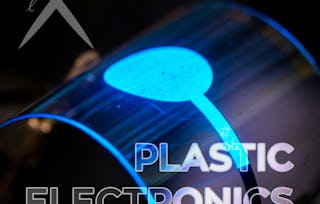
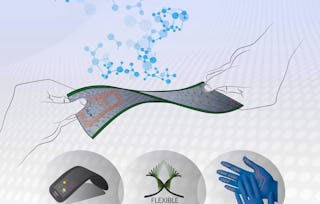
In this course, the learners will understand fundamental basic backgrounds of p-n junctions, diodes and MOSFETs (Metal Oxide Semiconductor Field Effect Transistors). Also, recent approaches on flexible / stretchable electronics, transparent optoelectronics, and printed electronics using one dimensional or two dimensional nanomaterials will be introduced. Furthermore, the formation of high-performance, transparent thin films or conductors using novel materials such as cellulose nanofibers or metal nanofibers is included for course materials. Examples of device fabrications, including touch screen panels, gas / chemical / bio sensors, smart contact lenses, wireless and transparent antennas, and OLEDs, are also introduced for next generation electronic devices.

Recent Advances in Freeform Electronics

Recent Advances in Freeform Electronics

Instructor: Jang-Ung Park
6,254 already enrolled
Included with Learn more
Gain insight into a topic and learn the fundamentals.
116 reviews
Intermediate level
Some related experience required
1 week to complete
at 10 hours a week
Details to know

Shareable certificate
Add to your LinkedIn profile
Assessments
6 assignments
Taught in English
Flexible schedule
Learn at your own pace
See how employees at top companies are mastering in-demand skills

There are 6 modules in this course
Instructor
Instructor ratings
(44 ratings)Offered by

Explore more from Electrical Engineering
École Polytechnique
University of Colorado Boulder
Technion - Israel Institute of Technology

Coursera
Why people choose Coursera for their career

Felipe M.
Learner since 2018
"To be able to take courses at my own pace and rhythm has been an amazing experience. I can learn whenever it fits my schedule and mood."

Jennifer J.
Learner since 2020
"I directly applied the concepts and skills I learned from my courses to an exciting new project at work."

Larry W.
Learner since 2021
"When I need courses on topics that my university doesn't offer, Coursera is one of the best places to go."

Chaitanya A.
"Learning isn't just about being better at your job: it's so much more than that. Coursera allows me to learn without limits."
Learner reviews
- 5 stars
75%
- 4 stars
18.96%
- 3 stars
5.17%
- 2 stars
0.86%
- 1 star
0%
Showing 3 of 116
IS
4.0
Reviewed on Mar 26, 2026
Clear and interesting. Adding the lecture presentations to the reading material would be a vast improvement (certainly for those who do not have access to scientific journals).
IA
5.0
Reviewed on Apr 19, 2020
Amazing course, Highly attractive topics are included
LJ
5.0
Reviewed on Sep 14, 2023
It is a concise and well-organized course. I find it useful for research in flexible electronics.
What brings you to Coursera today?
Advance your career with an online degree
Earn a degree from world-class universities - 100% online



