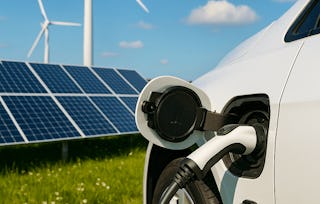
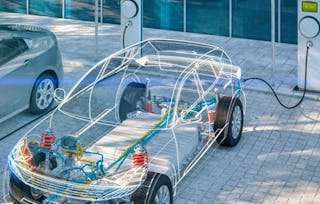
“Electric Vehicle Sensors” starts with a discussion on how electric vehicles work differently from gasoline or diesel fuel powered vehicles and the major types of electric vehicles. It then moves to the unique components of full electric and hybrid electric vehicles, and how in-vehicle and external battery charging systems work. We reference all the sensors that are used for in-vehicle and outside unique components. Then we do a deep dive into how each of these sensors work.

Electric Vehicle Sensors

Electric Vehicle Sensors
This course is part of Sensors for a Carbon Free World Specialization

Instructor: Jay Mendelson
3,921 already enrolled
Included with
Gain insight into a topic and learn the fundamentals.
66 reviews
Intermediate level
Recommended experience
Flexible schedule
4 weeks at 10 hours a week
Learn at your own pace
Build toward a degree
What you'll learn
Examine traction motor, inverter, transmission and battery charging hardware
Specify the correct sensor for an electric vehicle application
Skills you'll gain
- Engineering, Scientific, and Technical Instruments
- Engineering Calculations
- Electrical Engineering
- Energy and Utilities
- Electronic Components
- Electric Power Systems
- Machine Controls
- Electrical Systems
- Torque (Physics)
- Thermal Management
- High Voltage
- Semiconductors
- Mechanics
- Basic Electrical Systems
- Power Electronics
Details to know

Shareable certificate
Add to your LinkedIn profile
Assessments
4 assignments
Taught in English
See how employees at top companies are mastering in-demand skills

Build your subject-matter expertise
This course is part of the Sensors for a Carbon Free World Specialization
When you enroll in this course, you'll also be enrolled in this Specialization.
- Learn new concepts from industry experts
- Gain a foundational understanding of a subject or tool
- Develop job-relevant skills with hands-on projects
- Earn a shareable career certificate

There are 4 modules in this course
Earn a career certificate
Add this credential to your LinkedIn profile, resume, or CV. Share it on social media and in your performance review.
Build toward a degree
This course is part of the following degree program(s) offered by University of Colorado Boulder. If you are admitted and enroll, your completed coursework may count toward your degree learning and your progress can transfer with you.¹
Instructor
Instructor ratings
(22 ratings)Offered by


Explore more from Electrical Engineering
University of Colorado Boulder
Arizona State University
Why people choose Coursera for their career

Felipe M.
Learner since 2018
"To be able to take courses at my own pace and rhythm has been an amazing experience. I can learn whenever it fits my schedule and mood."

Jennifer J.
Learner since 2020
"I directly applied the concepts and skills I learned from my courses to an exciting new project at work."

Larry W.
Learner since 2021
"When I need courses on topics that my university doesn't offer, Coursera is one of the best places to go."

Chaitanya A.
"Learning isn't just about being better at your job: it's so much more than that. Coursera allows me to learn without limits."
Advance your career with an online degree
Earn a degree from world-class universities - 100% online



