When you enroll in this course, you'll also be enrolled in this Specialization.
Learn new concepts from industry experts
Gain a foundational understanding of a subject or tool
Develop job-relevant skills with hands-on projects
Earn a shareable career certificate
There are 5 modules in this course
In the third course, Cosmetic Product Development, we analyze every step of developing cosmetic products. We cover everything, including how you would generate ideas, how you know what the customer wants, and feasibility studies. We strongly emphasize collaboration and prototype development, along with how we design and select cosmetic packaging. We engage with raw material suppliers and navigate international manufacturing regulations. You will also learn to evaluate cosmetic product performance, market trends, and sustainable practices. We designed this course to give you a holistic understanding of the cosmetic product development process within industry standards.e.g. This is primarily aimed at first- and second-year undergraduates interested in engineering or science, along with high school students and professionals with an interest in programming.
This module covers the essential early stages of cosmetic product development, focusing on customer needs and idea generation. We will explore consumer psychology, data collection methods, and innovative idea-generation techniques. The module also delves into feasibility studies and conceptualization, emphasizing the evaluation of product design principles, idea viability, and proof of concept. It concludes with prototype development and refinement, highlighting the collaborative process and iterative adjustments based on feedback. Let’s begin!
Overview of Collaboration in Product Development•4 minutes
Research and Development•4 minutes
Evaluating Prototype Design•5 minutes
Adjusting the Prototype Based on Feedback•6 minutes
10 readings•Total 118 minutes
Introduction to the Cosmetic Product Development Syllabus•15 minutes
Meet Your Instructors•5 minutes
How to Be Successful in This Course•5 minutes
From Consumer Insights to Early Product Concepts•15 minutes
Techniques for Generating Innovative Ideas•15 minutes
Feasibility Studies•15 minutes
Cross-Functional Collaboration•15 minutes
Steps in Creating a Cosmetic Product Prototype•15 minutes
Experimental Methods in Product Development•8 minutes
Exemplar: Interpret Consumer Insights and Propose an Early Product Idea•10 minutes
5 assignments•Total 165 minutes
Practice Quiz: Customer Needs and Idea Generation•15 minutes
Practice Quiz: Feasibility Studies and Conceptualization•5 minutes
Hands-On Activity: Interpret Consumer Insights and Propose an Early Product Idea•60 minutes
Practice Quiz: Prototype Development and Refinement•35 minutes
Checkpoint: Module 1•50 minutes
2 discussion prompts•Total 60 minutes
Getting to Know Your Peers•15 minutes
The Niche Hunt: Unearthing Your Cosmetic Innovations•45 minutes
Market Analysis and Consumer Behavior
Module 2•7 hours to complete
Module details
In this module, we will explore the key factors influencing consumer behavior in the cosmetics industry. We will analyze both primary and secondary data to understand the drivers behind purchasing decisions. We’ll also dive into market dynamics, competitive positioning, and customer segmentation, using various tools and frameworks to develop products that meet consumer needs. By the end of this module, you’ll be able to apply market insights to make strategic product decisions that align with trends and consumer expectations. Let’s begin!
Decoding Consumer Behavior in the Cosmetics Industry•3 minutes
The Psychology Behind Beauty Buying Decisions•3 minutes
Understanding Market Dynamics in the Global Beauty Industry•4 minutes
Innovation and Disruption: Responding to Market Change•4 minutes
Principles of Customer Segmentation in the Beauty Industry•4 minutes
Building Personas and Identifying Target Markets•4 minutes
From Insight to Strategy: Connecting Research to Decision-Making•4 minutes
Strategic Innovation Planning and Portfolio Management•7 minutes
9 readings•Total 135 minutes
Turning Market Research Into Strategy•15 minutes
Creating Competitive Advantage: SWOT and Positioning in Beauty Brands•15 minutes
Tools and Frameworks for Market Analysis•15 minutes
Creating a Market Positioning Strategy for Skincare Brands•15 minutes
Data-Driven Segmentation: From Demographics to Behavioral Insights•15 minutes
Applying Segmentation Insights to Product Development•15 minutes
Forecasting Future Trends in the Beauty Market•15 minutes
Communicating Insights Across Teams and Stakeholders•15 minutes
Exemplar: Building a Target Persona From Consumer Insights•15 minutes
6 assignments•Total 190 minutes
Practice Quiz: Understanding Market and Consumer Foundations•20 minutes
Practice Quiz: Analyzing Market Dynamics and Competitive Positioning•20 minutes
Practice Quiz: Customer Segmentation and Targeting in Skincare Development•20 minutes
Hands-On Activity: Building a Target Persona From Consumer Insights•60 minutes
Practice Quiz: Translating Market Insights Into Strategic Product Decisions•20 minutes
Check Point: Module 2•50 minutes
1 discussion prompt•Total 45 minutes
Trend Forecasting and Consumer Insight in Beauty•45 minutes
Packaging and Manufacturing Considerations
Module 3•6 hours to complete
Module details
In this module, we will embark on the exciting journey of cosmetic product development. Starting with design and material selection for packaging, we’ll explore packaging functional design principles, the importance of evaluating costs and benefits, and delve into sustainability practices. Moving on to the manufacturing process, we’ll uncover the steps involved in manufacturing cosmetics, learn more about different types of raw material suppliers and how to engage with them, look at the process of scaling production from laboratory batch through to a manufacturing run, and explore Good Manufacturing Practices (GMP). Lastly, we’ll cover safety standards, legal insights, international regulations, and labeling compliance, and address how to tackle compliance issues effectively. Let’s begin!
Impact of Laws and Regulations on Product Development•5 minutes
Compliance with International Regulations•5 minutes
Addressing Compliance Issues•5 minutes
3 readings•Total 38 minutes
Cosmetic Compliance: A Guide for Product Developers•8 minutes
Labeling and Packaging Regulatory Compliance•15 minutes
Exemplar: Scaling Production: Supplier Evaluation and GMP Checklist•15 minutes
5 assignments•Total 175 minutes
Practice Quiz: Design and Material Selection for Packaging•15 minutes
Practice Quiz: Manufacturing Process•20 minutes
Hands-On Activity: Scaling Production: Supplier Evaluation and GMP Checklist•60 minutes
Practice Quiz: Safety and Regulatory Compliance in Manufacturing•30 minutes
Checkpoint: Module 3•50 minutes
2 discussion prompts•Total 90 minutes
Sustainable Packaging•45 minutes
Impact of International Regulations on Manufacturing Decisions•45 minutes
Performance Evaluation
Module 4•7 hours to complete
Module details
In this module, we will explore the essential aspects of performance evaluation in cosmetic product development. Beginning with stability testing, we’ll clarify the various types of product testing and delve into techniques for performance evaluation, focusing on evaluation methodologies for diverse cosmetic products. Building on this, we’ll discuss adjusting based on performance evaluation, demonstrating how to modify products based on compiled data. To ensure consistent product quality, we’ll outline the steps needed to maintain quality control. Additionally, we’ll cover ethical testing to ensure products align with legal and ethical standards. Shifting our focus to the product launch, we’ll explore preparation steps, roll-out strategies, and supply chain management to reduce risk and improve efficiency, followed by post-launch evaluation techniques and consumer feedback analysis for continuous improvement. Let’s begin!
In this module, we explore the diverse aspects involved in developing cosmetic products. We’ll assess the formula’s alignment with current market needs by reviewing trends and gauging its success accordingly. You’ll discover why, when looking for methods to maximize and differentiate, the assessment of novel materials is essential. To make your formulas environmentally friendly, we will also examine several methods to ensure formula optimization, understand the fine line between quality and cost, assess different formula designs, and investigate sustainable applications. Let’s begin!
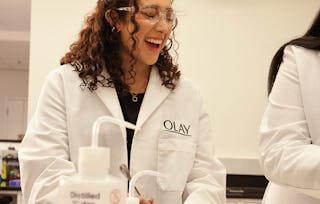
OLAY is a worldwide leader in skin care and dermatologist recommended brand that has been trusted by women for over seventy years. OLAY maintains a deep understanding of women’s changing needs and offers products backed by superior science to meet them. OLAY recognizes the importance of gender equality in Science, Technology, Engineering and Mathematics (STEM), which is why OLAY is committed to #FacetheSTEMGap by helping to double the number of women in STEM and triple the number of women of color in STEM by 2030. OLAY has developed the Cosmetic Science Specialization to help anyone and everyone who have a passion for skincare to develop their expertise.
When will I have access to the lectures and assignments?
To access the course materials, assignments and to earn a Certificate, you will need to purchase the Certificate experience when you enroll in a course. You can try a Free Trial instead, or apply for Financial Aid. The course may offer 'Full Course, No Certificate' instead. This option lets you see all course materials, submit required assessments, and get a final grade. This also means that you will not be able to purchase a Certificate experience.
What will I get if I subscribe to this Specialization?
When you enroll in the course, you get access to all of the courses in the Specialization, and you earn a certificate when you complete the work. Your electronic Certificate will be added to your Accomplishments page - from there, you can print your Certificate or add it to your LinkedIn profile.
Is financial aid available?
Yes. In select learning programs, you can apply for financial aid or a scholarship if you can’t afford the enrollment fee. If fin aid or scholarship is available for your learning program selection, you’ll find a link to apply on the description page.