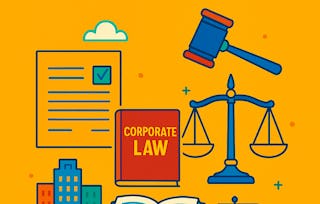
This course is the second course in a two-part series on corporate and commercial law. In this part, we focus on three main topics: business organizations, business financing, and governmental regulation. In the first module, we discuss the characteristics of a number of the most common forms of business entities, such as corporations and LLCs. Module two is devoted to debtor-creditor relationships, including bank financing, debt financing, secured transactions, and bankruptcy. We wrap up the course with two modules that focus on the most important aspects of governmental regulation, including the process by which administrative agencies make rules, and the regulation of anti-competitive behavior and securities transactions.
In this module, you will become familiar with the course, your instructor and your classmates, and our learning environment. This orientation will also help you obtain the technical skills required to navigate and be successful in this course.
What's included
3 videos5 readings1 assignment1 discussion prompt
Show info about module content
3 videos•Total 6 minutes
Course Overview•3 minutes
About Professor Fricke•3 minutes
Learn on Your Terms•1 minute
5 readings•Total 50 minutes
Syllabus•10 minutes
About the Discussion Forums•10 minutes
Online Education at Gies College of Business•10 minutes
Update Your Profile•10 minutes
Build a Learning Community with Social Media•10 minutes
1 assignment•Total 30 minutes
Orientation Quiz•30 minutes
1 discussion prompt•Total 30 minutes
Get to Know Your Classmates•30 minutes
Module 1: Business Organizations
6 hours to complete
Module details
In this module, you will learn about the most common forms of business organizations. Beginning with sole proprietorships and moving on through various forms of partnerships, corporations, and limited liability companies, we will discuss how each type of business entity is formed and how it operates. By the end of this module, you will be able to differentiate between the most important types of business organizations and understand which form is most appropriate for achieving certain business goals.
What's included
8 videos1 reading9 assignments
Show info about module content
8 videos•Total 65 minutes
Introduction to Sole Proprietorships and Partnerships•8 minutes
Director & Officer Rights, Duties, & Liability•5 minutes
Limited Liability Companies•9 minutes
1 reading•Total 10 minutes
Module 1 Overview and Resources•10 minutes
9 assignments•Total 270 minutes
Module 1 Quiz•30 minutes
Lesson 1.1 Knowledge Check•30 minutes
Lesson 1.2 Knowledge Check•30 minutes
Lesson 1.3 Knowledge Check•30 minutes
Lesson 1.4 Knowledge Check•30 minutes
Lesson 1.5 Knowledge Check•30 minutes
Lesson 1.6 Knowledge Check•30 minutes
Lesson 1.7 Knowledge Check•30 minutes
Lesson 1.8 Knowledge Check•30 minutes
Module 2: Debtor-Creditor Relationships
6 hours to complete
Module details
In this module, we will learn about the laws that govern the relationship between a lender and a borrower. We will discuss the basics of bank financing and debt financing, with special attention paid to loans that are secured by collateral consisting of personal property. We wrap up the module with several lessons explaining the bankruptcy process, and how debtors and creditors navigate the three most common forms of bankruptcy.
Module 3: Regulation Part I: Foundations, Consumers, and the Environment
5 hours to complete
Module details
In this module, you will learn about administrative agencies and how they regulate many aspects of business. We will talk about how agencies make rules and then how they enforce those rules. Then we will look at a series of important federal agencies and learn about how they operate within the scope of their authority. By the end of this module, you will understand the basics of the administrative rule-making process and know some of the primary regulatory activities of the FTC, CFPB, FDA, and EPA.
CFPB Regulation of Financial Institutions•6 minutes
FDA Regulation of Food, Drugs, & Cosmetics•4 minutes
EPA Regulation of Pollution•8 minutes
1 reading•Total 10 minutes
Module 3 Overview and Resources•10 minutes
8 assignments•Total 240 minutes
Module 3 Quiz•30 minutes
Lesson 3.1 Knowledge Check•30 minutes
Lesson 3.2 Knowledge Check•30 minutes
Lesson 3.3 Knowledge Check•30 minutes
Lesson 3.4 Knowledge Check•30 minutes
Lesson 3.5 Knowledge Check•30 minutes
Lesson 3.6 Knowledge Check•30 minutes
Lesson 3.7 Knowledge Check•30 minutes
Module 4: Regulation Part II: Antitrust and Securities
7 hours to complete
Module details
In this module, we continue our discussion of administrative regulations from the previous module, focusing specifically on antitrust and securities regulation. Prohibiting anti-competitive behavior and ensuring fair securities transactions are two of the most important ways the government regulates commerce. By the end of this module, you will understand the basics of federal antitrust and securities laws.
Congratulations on completing the course!•10 minutes
Get Your Course Certificate•10 minutes
10 assignments•Total 300 minutes
Module 4 Quiz•30 minutes
Lesson 4.1 Knowledge Check•30 minutes
Lesson 4.2 Knowledge Check•30 minutes
Lesson 4.3 Knowledge Check•30 minutes
Lesson 4.4 Knowledge Check•30 minutes
Lesson 4.5 Knowledge Check•30 minutes
Lesson 4.6 Knowledge Check•30 minutes
Lesson 4.7 Knowledge Check•30 minutes
Lesson 4.8 Knowledge Check•30 minutes
Lesson 4.9 Knowledge Check•30 minutes
1 discussion prompt•Total 30 minutes
Final Reflection: What Will You Do with It?•30 minutes
Build toward a degree
This course is part of the following degree program(s) offered by University of Illinois Urbana-Champaign. If you are admitted and enroll, your completed coursework may count toward your degree learning and your progress can transfer with you.¹
View eligible degrees
Build toward a degree
This course is part of the following degree program(s) offered by University of Illinois Urbana-Champaign. If you are admitted and enroll, your completed coursework may count toward your degree learning and your progress can transfer with you.¹
¹Successful application and enrollment are required. Eligibility requirements apply. Each institution determines the number of credits recognized by completing this content that may count towards degree requirements, considering any existing credits you may have. Click on a specific course for more information.
OK
Instructor
Instructor ratings
Instructor ratings
We asked all learners to give feedback on our instructors based on the quality of their teaching style.
The University of Illinois at Urbana-Champaign is a world leader in research, teaching and public engagement, distinguished by the breadth of its programs, broad academic excellence, and internationally renowned faculty and alumni. Illinois serves the world by creating knowledge, preparing students for lives of impact, and finding solutions to critical societal needs.
"To be able to take courses at my own pace and rhythm has been an amazing experience. I can learn whenever it fits my schedule and mood."
Jennifer J.
Learner since 2020
"I directly applied the concepts and skills I learned from my courses to an exciting new project at work."
Larry W.
Learner since 2021
"When I need courses on topics that my university doesn't offer, Coursera is one of the best places to go."
Chaitanya A.
"Learning isn't just about being better at your job: it's so much more than that. Coursera allows me to learn without limits."
Learner reviews
4.9
393 reviews
5 stars
88.54%
4 stars
9.16%
3 stars
1.52%
2 stars
0.50%
1 star
0.25%
Showing 3 of 393
M
MP
5·
Reviewed on Apr 6, 2022
Great effort in providing knowledge about the basic concepts of Corporate law in US
K
K
4·
Reviewed on Jul 5, 2021
i really enjoyed this course and understand various expect of business
R
RC
5·
Reviewed on Apr 20, 2021
Excellent course , well planned and executed covers various eventualities and challenges and being a professor of Commercial law find these course very interesting
When will I have access to the lectures and assignments?
Once you enroll for a Certificate, you’ll have access to all videos, quizzes, and programming assignments (if applicable). If you choose to explore the course without purchasing, you may not be able to access certain assignments.
What is the refund policy?
You will be eligible for a full refund until 2 weeks after your payment date. You cannot receive a refund once you’ve earned a Course Certificate, even if you complete the course within the 2-week refund period. View our full refund policy.
Is financial aid available?
Yes! Coursera provides financial aid to learners who would like to complete a course but cannot afford the course fee. To apply for aid, select "Learn more and apply" in the Financial Aid section below the "Enroll" button. You'll be prompted to complete a simple application; no other paperwork is required.
What will I get if I subscribe to this Specialization?
When you enroll in the course, you get access to all of the courses in the Specialization, and you earn a certificate when you complete the work. Your electronic Certificate will be added to your Accomplishments page - from there, you can print your Certificate or add it to your LinkedIn profile.