Results for "zoology"

The University of Edinburgh
Skills you'll gain: Behavioral Health, Pain Management, Applied Behavior Analysis, Scientific Methods, Behavior Management, Stress Management, Empathy & Emotional Intelligence, Ethical Standards And Conduct, Qualitative Research, Science and Research, Physiology
 Status: Free Trial
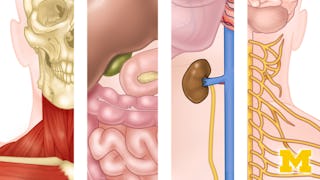
University of Michigan
Skills you'll gain: Sensory Systems Analysis, Human Musculoskeletal System, Anatomy, Endocrinology, Pulmonology, Cardiology, Respiration, Hematology, Obstetrics And Gynecology, Orthopedics, Neurology, Hemodynamics, Nephrology, Kinesiology, Physiology, Urology, Pathology, Immunology, Biology
 Status: Preview
American Museum of Natural History
Skills you'll gain: Environment, Systems Thinking, Environmental Science, Natural Resource Management, Sustainable Systems, Environmental Issue, Environment and Resource Management, Biology, Sustainable Development, Environmental Engineering and Restoration, Life Sciences, Environmental Monitoring, Demography, Community Development, Case Studies, Scientific Methods
 Status: Free Trial
Rice University
Skills you'll gain: Biology, Environment, Microbiology, Life Sciences, Environmental Science, Molecular, Cellular, and Microbiology, Environmental Issue, Environmental Resource Management, Environment and Resource Management, Sustainable Development, Demography, Natural Resource Management, Taxonomy, Cell Biology, Anatomy, Climate Change Adaptation, Estimation, Infectious Diseases, Molecular Biology, Mathematical Modeling
 Status: NewStatus: Free Trial
University of Minnesota
Skills you'll gain: Pharmacology, Pharmacotherapy, Clinical Pharmacy, Molecular Biology, Substance Abuse, Mental and Behavioral Health, Neurology, Physiology, Psychology, Biochemistry, Biology, Developmental Disabilities, Science and Research
 Status: Free Trial
University of Colorado Boulder
Skills you'll gain: Culture, Social Studies, Social Sciences, Sociology, Anthropology, Social Justice, Healthcare Ethics, Environment, Laboratory Research, Mental Health, General Science and Research, Media and Communications, Health Care, Cultural Diversity, Mental and Behavioral Health, Food and Beverage, Social Impact, Rehabilitation, Ethical Standards And Conduct, Advocacy
What brings you to Coursera today?
 Status: Preview
American Museum of Natural History
Skills you'll gain: Life Sciences, Biology, Environmental Science, Environment, Physiology, Hydrology, Environmental Issue, Anatomy, Natural Resource Management, Environmental Resource Management, General Science and Research, Environment and Resource Management, Science and Research, Research, Research Methodologies
 Status: Free Trial
Lecturio
Skills you'll gain: Molecular Biology, Biochemistry, Cell Biology, Molecular, Cellular, and Microbiology, Life Sciences, Pharmacology, Biology
 Status: Free
University of Alberta
Skills you'll gain: Infectious Diseases, Social Studies, Anthropology, Anatomy, Physiology, Socioeconomics, Life Sciences, Sustainable Systems, Environment and Resource Management, Environmental Science, Biology, Microbiology, Public Health and Disease Prevention, Pollution Prevention, Taxonomy, Criminal Investigation and Forensics, Art History, Environmental Monitoring
 Status: Free
University of Alberta
Skills you'll gain: Biology, Life Sciences, Taxonomy, Environment, Scientific Methods, Timelines, Environmental Science, Mechanics
 Status: Free Trial
Lecturio
Skills you'll gain: Microbiology, Infection Control, Infectious Diseases, Hand Hygiene, Bloodborne Pathogens, Public Health and Disease Prevention, Immunology, Biology, Molecular Biology, Cell Biology, Taxonomy
 Status: Preview
American Museum of Natural History
Skills you'll gain: Life Sciences, Biology, Environment, Taxonomy, Laboratory Research, Science and Research, Scientific Methods, Timelines, Research, Scientific Visualization, Research Methodologies, Laboratory Experience
In summary, here are 10 of our most popular zoology courses
- Animal Behaviour and Welfare: The University of Edinburgh
- Anatomy: University of Michigan
- Ecology: Ecosystem Dynamics and Conservation: American Museum of Natural History
- Introduction to Biology: Ecology, Evolution, & Biodiversity: Rice University
- Genetic Underpinnings of Synaptic Disease: University of Minnesota
- Animals and Society: University of Colorado Boulder
- Marine Biology: American Museum of Natural History
- Molecular and Cell Biology: Lecturio
- Bugs 101: Insect-Human Interactions: University of Alberta
- Dino 101: Dinosaur Paleobiology: University of Alberta










