Results for "medical"

Rice University
Skills you'll gain: Medical Terminology, Medical History Documentation, Pulmonology, Cardiology, Electronic Medical Record System, Medical Records, Endocrinology, Human Musculoskeletal System, Respiratory Care, Orthopedics, Obstetrics And Gynecology, Respiration, Neurology, Gynecology, Urology, Hematology, Health Information Management and Medical Records, Anatomy, Immunology, Communication

Skills you'll gain: Medical Terminology, Anatomy, Pathology, Medical Records, Physiology, Cell Biology, Diagnostic Tests, Nutrition and Diet

Johns Hopkins University
Skills you'll gain: Medical Billing and Coding, Denial Management, Patient Registration, Care Management, Medical Privacy, Revenue Cycle Management, Practice Management, Organizational Change, Change Management, Health Insurance Portability And Accountability Act (HIPAA) Compliance, Performance Review, Data Management, ICD Coding (ICD-9/ICD-10), Medical Terminology, Claims Processing, Medical Billing, Patient Safety, Continuous Quality Improvement (CQI), Medical Management, Data Analysis

Skills you'll gain: Phlebotomy, Blood Collection, Sterilization, Urinalysis, Patient Communication, Medical Terminology, Patient-centered Care, Nutrition Education, Infection Control, Asepsis, Nutrition and Diet, Pathology, Basic Patient Care, Patient Education And Counseling, Vital Signs, Geriatrics, Laboratory Testing, Direct Patient Care, Venipuncture, Hand Hygiene
University of Michigan
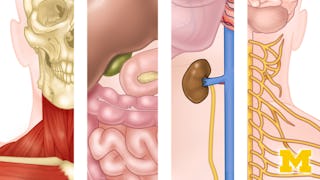
Skills you'll gain: Sensory Systems Analysis, Human Musculoskeletal System, Anatomy, Endocrinology, Pulmonology, Cardiology, Respiration, Hematology, Obstetrics And Gynecology, Orthopedics, Neurology, Hemodynamics, Nephrology, Kinesiology, Physiology, Urology, Pathology, Immunology, Biology
Skills you'll gain: Medical Billing, Denial Management, Medical Billing and Coding, Medical Coding, ICD Coding (ICD-9/ICD-10), Billing, Patient Registration, CPT Coding, Accounts Receivable, Payment Processing and Collection, Billing & Invoicing, Health Information Management, Medical Records, Utilization Management, Clinical Documentation, Health Systems, Insurance, Medicare, Healthcare Industry Knowledge, Regulatory Compliance
What brings you to Coursera today?

Skills you'll gain: Medical Terminology, Revenue Cycle Management, Healthcare Ethics, Medical Billing, Medical Billing and Coding, Conflict Management, Electronic Medical Record System, Patient Communication, Anatomy, Pathology, Medical Coding, Cultural Responsiveness, Intercultural Competence, Medical History Documentation, ICD Coding (ICD-9/ICD-10), Patient-centered Care, Electronic Medical Record, Medical Records, Physiology, Payment Processing

Skills you'll gain: Medical Terminology, Pulmonology, Pathology, Endocrinology, Cardiology, Medical Records, Neurology, Respiratory Care, Obstetrics And Gynecology, General Medical Tests and Procedures, Urology, Gynecology, Anatomy, Human Musculoskeletal System, Respiration, Medical Practices and Procedures, Urinalysis, Sensory Systems Analysis, Hemodynamics, Cell Biology

Skills you'll gain: Medical Privacy, Medical Records, Healthcare Ethics, Medical Office Procedures, Electronic Medical Record System, Health Information Management and Medical Records, Conflict Management, Health Information Management, Patient Communication, Health Insurance Portability And Accountability Act (HIPAA) Compliance, Electronic Medical Record, Patient Coordination, Cultural Responsiveness, Intercultural Competence, Patient Registration, Medical History Documentation, Care Coordination, Patient-centered Care, Professionalism, Medical Assistance

Duke University
Skills you'll gain: Sensory Systems Analysis, Neurology, Physiology, Anatomy, Life Sciences, Electrophysiology, Cell Biology, Psychology, Pathology, Molecular Biology
DeepLearning.AI
Skills you'll gain: Model Evaluation, Patient Evaluation, Data Preprocessing, Diagnostic Tests, Convolutional Neural Networks, Image Analysis, Diagnostic Radiology, Predictive Modeling, Risk Modeling, Statistical Machine Learning, Artificial Intelligence, Predictive Analytics, Applied Machine Learning, Medical Imaging, Machine Learning Methods, Computer Vision, Deep Learning, Natural Language Processing, Machine Learning, Radiology

Skills you'll gain: Medical Billing, Medical Billing and Coding, Medical Coding, Revenue Cycle Management, ICD Coding (ICD-9/ICD-10), CPT Coding, Medical Office Procedures, Health Information Management and Medical Records, Claims Processing, Billing, Billing & Invoicing, Clinical Documentation, Health Information Management, Electronic Medical Record, Health Administration, Medical Terminology, System Monitoring, Site Reliability Engineering, Adjudication, Ansible
In summary, here are 10 of our most popular medical courses
- Medical Terminology: Rice University
- Medical Terminology and the Human Body Fundamentals: MedCerts
- Johns Hopkins Medical Office Manager: Johns Hopkins University
- Clinical Medical Assistant Fundamentals: MedCerts
- Anatomy: University of Michigan
- AAPC Medical Biller: AAPC
- Medical Billing and Coding Fundamentals: MedCerts
- Human Anatomy and Medical Terminology Fundamentals: MedCerts
- Medical Office Procedures and Administration Fundamentals: MedCerts
- Medical Neuroscience: Duke University










