Results for "differential equation"
 Status: Free Trial
The Hong Kong University of Science and Technology
Skills you'll gain: Differential Equations, Engineering Analysis, Applied Mathematics, Calculus, Integral Calculus, Numerical Analysis, Mathematical Modeling, Advanced Mathematics, Linear Algebra, Vibrations, Algebra, Electrical Engineering, Derivatives
 Status: Free Trial
Johns Hopkins University
Skills you'll gain: Calculus, Applied Mathematics, Data Modeling, Model Optimization, Estimation, Graphing, Mathematical Modeling, Data Analysis Software, Algebra, Cost Estimation, Mathematical Software, Linear Algebra, Trigonometry, General Mathematics, Advanced Mathematics, Analysis, Derivatives, Mathematical Theory & Analysis, Geometry, Data Analysis
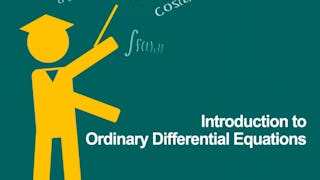 Status: Preview
Korea Advanced Institute of Science and Technology(KAIST)
Skills you'll gain: Differential Equations, Applied Mathematics, Mathematical Modeling, Calculus, Mechanics
 Status: Free Trial
The Hong Kong University of Science and Technology
Skills you'll gain: Differential Equations, Linear Algebra, Matlab, Engineering Analysis, Numerical Analysis, Integral Calculus, Mathematical Software, Calculus, Engineering Calculations, electromagnetics, Algebra, Applied Mathematics, Mathematical Modeling, Engineering, Advanced Mathematics, Geometry, Computational Thinking, Simulation and Simulation Software, Mechanics, Scripting
 Status: Free Trial
University of Colorado Boulder
Skills you'll gain: Estimation, Electrical Engineering, Numerical Analysis, Linear Algebra, Physics, Angular, Applied Mathematics, Advanced Mathematics, Mathematical Modeling, Mechanics, Calculus, Differential Equations, Engineering Analysis, Physical Science
The University of Sydney
Skills you'll gain: Advanced Mathematics, Integral Calculus, Calculus, Mathematical Theory & Analysis, Differential Equations, Applied Mathematics, Trigonometry, Mathematical Modeling, Linear Algebra, Physics, Numerical Analysis, Derivatives
What brings you to Coursera today?

University of Colorado Boulder
Skills you'll gain: Control Systems, Mathematical Modeling, Engineering Analysis, Differential Equations, Systems Analysis, Electrical Systems, Mechanics, Systems Thinking, Applied Mathematics, Performance Testing, Integral Calculus, Basic Electrical Systems
 Status: NewStatus: Preview
Birla Institute of Technology & Science, Pilani
Skills you'll gain: Differential Equations, Applied Mathematics, Engineering Analysis, Linear Algebra, Calculus, Advanced Mathematics, Mathematical Modeling, Integral Calculus, Dependency Analysis, Mathematical Theory & Analysis, Derivatives
 Status: New
University of Huddersfield
Skills you'll gain: Calculus, Advanced Mathematics, Differential Equations, Applied Mathematics, Model Optimization, Mathematical Theory & Analysis, Mathematical Modeling, Analytical Skills, Engineering Analysis, Derivatives
 Status: Preview
Korea Advanced Institute of Science and Technology(KAIST)
Skills you'll gain: Differential Equations, Applied Mathematics, Advanced Mathematics, Linear Algebra, Calculus, Mathematical Modeling, Mathematical Theory & Analysis
 Status: Preview
Korea Advanced Institute of Science and Technology(KAIST)
Skills you'll gain: Differential Equations, Applied Mathematics, Advanced Mathematics, Calculus, Integral Calculus, Linear Algebra, Mathematical Theory & Analysis
 Status: Free
University of Pennsylvania
Skills you'll gain: Calculus, Applied Mathematics, Derivatives, Estimation
In summary, here are 10 of our most popular differential equation courses
- Differential Equations for Engineers: The Hong Kong University of Science and Technology
- Differential Calculus through Data and Modeling: Johns Hopkins University
- Differential Equations Part I Basic Theory: Korea Advanced Institute of Science and Technology(KAIST)
- Mathematics for Engineers: The Hong Kong University of Science and Technology
- Quantum Mechanics for Engineers: University of Colorado Boulder
- Introduction to Advanced Calculus: The University of Sydney
- Control Systems Analysis: Modeling of Dynamic Systems: University of Colorado Boulder
- Differential Equations and Applications: Birla Institute of Technology & Science, Pilani
- Differential Equations & Advanced Applications: University of Huddersfield
- Differential Equations Part III Systems of Equations : Korea Advanced Institute of Science and Technology(KAIST)










