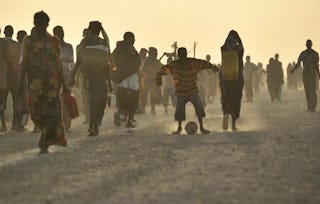
This MOOC provides insight into the refugee phenomenon as one of the most complex, compelling and (arguably) misunderstood features of the 21st century. Taking a global perspective, it will outline the fundamentals of who ‘refugees’ are, where they come from and where they go, as well as delving into the features of the global system for refugee protection and ‘solutions’ for those who have been forcibly displaced. It places the student at the centre of the learning experience through engagement with a range of robust and challenging activities, materials and online peer engagement.
This MOOC provides insight into the refugee phenomenon as one of the most complex, compelling and (arguably) misunderstood features of the 21st century. Taking a global perspective, it will outline the fundamentals of who ‘refugees’ are, where they come from and where they go, as well as delving into the features of the global system for refugee protection and ‘solutions’ for those who have been forcibly displaced. It places the student at the centre of the learning experience through engagement with a range of robust and challenging activities, materials and online peer engagement. This course has been developed by the Refugee Law Initiative at the renowned School of Advanced Study of the University of London, one of the leading research institutions working on refugee protection and forced migration studies. Please review the Course Introduction video and activities and then proceed to our first weekly lesson: 'A world of refugees'.
Introductory video - Welcome to ‘Refugees in the 21st Century’.•6 minutes
A world of refugees•9 minutes
5 readings•Total 186 minutes
Key information about course assignments and graded assessments•15 minutes
Recommended background reading•61 minutes
Week 1: A world of refugees - overview•10 minutes
Essential reading for Week 1•90 minutes
Note on the 'Global South' and 'Global North'•10 minutes
1 assignment•Total 30 minutes
(Graded) Week 1 assessment quiz•30 minutes
4 discussion prompts•Total 125 minutes
Introduce yourself and tell us what has motivated you to take this course•10 minutes
Where in the world are you based?•10 minutes
Why might some countries prefer to host refugees in camps?•30 minutes
Task and discussion on a country or region that most interests you•75 minutes
Week two: Who is a refugee?
Module 2•4 hours to complete
Module details
This session addresses the paramount question of who is a refugee. The concept of a ‘refugee’ can be interpreted in several ways. The session shows that, alongside the ‘everyday’ meaning of the term, the global refugee regime established by the international community also uses a ‘specialised’ technical understanding of the term. The session asks you to think how that technical term might be applied by governments and others in practice to different situations when deciding who qualifies as a ‘refugee’ deserving protection by the international community.This week we will be looking to explore the following areas: key aspects of what we mean when we use the term ‘refugee’; comparisons between the technical definition of a ‘refugee’ and everyday use of this term; key features of the technical ‘refugee’ definition in the 1951 Refugee Convention, and; ‘asylum seeker’ as a non-technical term merely for persons seeking to have their refugee status recognised.
What's included
1 video1 reading1 assignment4 discussion prompts
Show info about module content
1 video•Total 9 minutes
‘Who is a refugee?’•9 minutes
1 reading•Total 120 minutes
Essential reading for Week 2•120 minutes
1 assignment•Total 60 minutes
(Graded) Week two assessment quiz•60 minutes
4 discussion prompts•Total 75 minutes
Refugees or migrants?•15 minutes
Ways in which the legal definition of the term ‘refugee’ varies from its use in everyday speech?•15 minutes
Famous refugees - did you know that these people are refugees?•30 minutes
Who may not be included in the refugee definition?•15 minutes
Week three: The global 'system' of refugee protection
Module 3•4 hours to complete
Module details
In today’s world, there exists a ‘global system’ for responding to refugee arrivals. This session introduces you to two of the main features of this system: the 1951 Refugee Convention as the ‘cornerstone’ of refugee protection standards globally; and the Office of the United Nations High Commissioner for Refugees (UNHCR) as the global actor charged with the role of refugee protection by the international community. You are asked to reflect on the continuing relevance of this system, established in the middle of the 20th century, in the shifting contexts of the 21st century.This week we will be looking to explore the following areas: the global ‘system’ created by States for refugee protection; the main features of its legal ‘cornerstone’, the 1951 Refugee Convention, and; how the main institutional actor, UNHCR, fulfils its role in today’s world.
What's included
1 video1 reading1 peer review2 discussion prompts
Show info about module content
1 video•Total 9 minutes
'The global refugee protection regime'•9 minutes
1 reading•Total 150 minutes
Essential reading for Week 3•150 minutes
1 peer review•Total 75 minutes
(Graded) Peer review assessment•75 minutes
2 discussion prompts•Total 30 minutes
Is UNHCR’s mandate still achievable?•15 minutes
The Global Compact on Refugees•15 minutes
Week four: Solving the 'refugee problem'
Module 4•5 hours to complete
Module details
With forced displacement at such high levels, a crucial component of the refugee protection regime is finding durable, long-lasting solutions for refugees and displaced persons. This session introduces you to the three core ‘durable solutions’ for refugees: voluntary repatriation, local integration and resettlement. You will examine the similarities and differences between these forms of durable solution, and the challenges that lack of solutions in practice pose for refugees around the world. This week we will be looking to explore the following areas: the concept of ‘solutions’ for refugees as the end of refugee status; the similarities and differences between the three main ‘durable solutions’ for refugees, and; the process and challenges of (lack of) solutions in a real-life case study.
What's included
1 video1 reading1 assignment3 discussion prompts
Show info about module content
1 video•Total 7 minutes
Durable solutions for refugees•7 minutes
1 reading•Total 150 minutes
Essential reading for Week 4•150 minutes
1 assignment•Total 45 minutes
(Graded) Week 4 assessment quiz•45 minutes
3 discussion prompts•Total 100 minutes
Voluntary repatriation•15 minutes
Reframing the refugee 'problem'•15 minutes
Task and discussion on solutions for refugees•70 minutes
Week five: Refugees as migrants
Module 5•3 hours to complete
Module details
For a variety of reasons, some refugees move on from their first country or region of asylum to more geographically distant locations. Looking particularly at the European ‘crisis’ of 2015, this session explores the patterns and drivers of such refugee ‘mobility’ and how refugees undertaking these migratory journeys can get caught up in broader efforts to prevent or discourage irregular migration. This week we will be looking to explore the following areas: debates about the extent to which refugees are ‘migrants’; Government strategies to deter immigration and their impact on refugees, and; a case study of secondary movements and deterrence strategies.
What's included
1 video1 reading1 assignment3 discussion prompts
Show info about module content
1 video•Total 8 minutes
'Refugees as migrants’•8 minutes
1 reading•Total 120 minutes
Essential reading for Week 5•120 minutes
1 assignment•Total 30 minutes
(Graded) Week 5 assessment quiz•30 minutes
3 discussion prompts•Total 45 minutes
State measures to address the 2015 'crisis'•15 minutes
Cooperation with host and transit countries•15 minutes
Is there a refugee 'crisis'?•15 minutes
Week six: Only the tip of the ‘forced migration’ iceberg
Module 6•4 hours to complete
Module details
Refugees are not the only kind of forced migrants. Indeed, they represent only the tip of the iceberg so far as the wider universe of forced migrants in the 21st century is concerned. This session asks you to consider two of these other kinds of forced migrants lacking the protection of a State: stateless persons; and ‘internally displaced persons’ (IDPs). It focuses particularly on the similarities and differences between refugees and IDPs globally, including an assessment of the main protection challenges facing IDPs globally today. This week we will be looking to explore the following key areas: the wider range of forced migrants, including stateless persons, IDPs etc.; similarities and differences between refugees and conflict-IDPs globally, and; protection challenges in situations of internal displacement.
What's included
1 video1 reading1 peer review2 discussion prompts
Show info about module content
1 video•Total 8 minutes
Only the tip of the 'forced migration' iceberg•8 minutes
1 reading•Total 150 minutes
Essential reading for Week 6•150 minutes
1 peer review•Total 75 minutes
(Graded) Peer review assessment•75 minutes
2 discussion prompts•Total 30 minutes
The UN Guiding Principles on Internal Displacement•15 minutes
Internal displacement and refugee situations•15 minutes
Instructors
Instructor ratings
Instructor ratings
We asked all learners to give feedback on our instructors based on the quality of their teaching style.
The University of London is a federal University which includes 17 world leading Colleges. With extensive experience in distance learning since 1858, University of London has enriched the lives of thousands of students, delivering high quality degrees across the globe. Today, University of London is a global leader in flexible study, offering degree programmes to over 45,000 students in over 190 countries, delivering world-leading research across the world. To find out more about University of London, visit www.london.ac.uk
OK
Why people choose Coursera for their career
Felipe M.
Learner since 2018
"To be able to take courses at my own pace and rhythm has been an amazing experience. I can learn whenever it fits my schedule and mood."
Jennifer J.
Learner since 2020
"I directly applied the concepts and skills I learned from my courses to an exciting new project at work."
Larry W.
Learner since 2021
"When I need courses on topics that my university doesn't offer, Coursera is one of the best places to go."
Chaitanya A.
"Learning isn't just about being better at your job: it's so much more than that. Coursera allows me to learn without limits."
Learner reviews
4.8
576 reviews
5 stars
82.63%
4 stars
15.10%
3 stars
1.56%
2 stars
0.34%
1 star
0.34%
Showing 3 of 576
C
CA
5·
Reviewed on Nov 28, 2020
If you looking for more interactive course with your peers, this will meet your expectation. You will find lots of course materials to read that really give you deeper understanding on the subject.
A
AC
5·
Reviewed on Nov 6, 2022
I thought this course was really amazing in delivering an overall overview of the Refugee Situation in the 21st Century.
Great up-to-date reading examples and good assignment exercises.
M
MP
5·
Reviewed on Oct 9, 2020
The course is very informative and knowledgeable. Its fun to learn! If there could be more visuals and videos in this course it would have been even more good !

When will I have access to the lectures and assignments?
To access the course materials, assignments and to earn a Certificate, you will need to purchase the Certificate experience when you enroll in a course. You can try a Free Trial instead, or apply for Financial Aid. The course may offer 'Full Course, No Certificate' instead. This option lets you see all course materials, submit required assessments, and get a final grade. This also means that you will not be able to purchase a Certificate experience.
What will I get if I purchase the Certificate?
When you purchase a Certificate you get access to all course materials, including graded assignments. Upon completing the course, your electronic Certificate will be added to your Accomplishments page - from there, you can print your Certificate or add it to your LinkedIn profile.
Is financial aid available?
Yes. In select learning programs, you can apply for financial aid or a scholarship if you can’t afford the enrollment fee. If fin aid or scholarship is available for your learning program selection, you’ll find a link to apply on the description page.