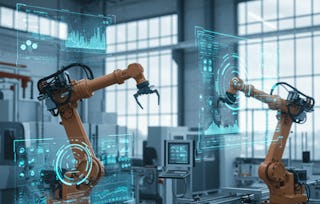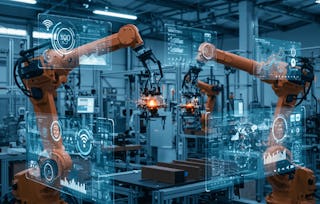


This industry 4.0 course gives you a working grasp of the fourth industrial revolution, built for engineers, production managers, and anyone asking what is industry 4.0 and how it reshapes manufacturing floors today.
Module 1 covers Digital Manufacturing: you study CAD, CAM, and CIM systems and see how they connect to build smart, connected factories. Module 2 masters IoT and Digital Twins: you explore sensors, connectivity layers, and how digital twins mirror real equipment for monitoring and simulation. Module 3 builds Additive Manufacturing: you examine 3D printing methods, industry standards, and where additive processes fit into production lines. Module 4 applies Robotics and Automation: you study industrial robot types, autonomous systems, and robotic process automation used on modern shop floors. By the End, You Will: - Analyze industry 4.0 technologies and map them to real manufacturing use cases - Apply IoT, digital twin, and additive manufacturing concepts to production challenges - Design a basic automation approach using robotics and RPA for a manufacturing process - Build a portfolio-ready case study connecting multiple industry 4.0 technologies Ideal For: manufacturing engineers, production managers, and industrial engineers exploring manufacturing 4.0; students curious about the fourth industrial revolution and its career paths. Manufacturing is being rebuilt around these tools. Enroll and start learning industry 4.0 today. Disclaimer: This is an independent educational resource created by Board Infinity for informational and educational purposes only. This course is not affiliated with, endorsed by, sponsored by, or officially associated with any company, organization, or certification body unless explicitly stated. The content provided is based on industry knowledge and best practices but does not constitute official training material for any specific employer or certification program. All company names, trademarks, service marks, and logos referenced are the property of their respective owners and are used solely for educational identification and comparison purposes.