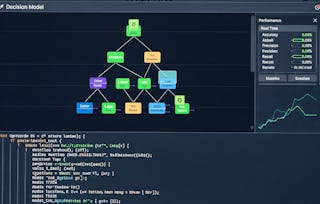
There are numerous types of machine learning algorithms, each of which has certain characteristics that might make it more or less suitable for solving a particular problem. Decision trees and support-vector machines (SVMs) are two examples of algorithms that can both solve regression and classification problems, but which have different applications. Likewise, a more advanced approach to machine learning, called deep learning, uses artificial neural networks (ANNs) to solve these types of problems and more. Adding all of these algorithms to your skillset is crucial for selecting the best tool for the job.

Build Decision Trees, SVMs, and Artificial Neural Networks
Ends soon! Learn with freedom this Fourth of July. Get 10,000+ programs for $239 (usually $399). Save now.

Build Decision Trees, SVMs, and Artificial Neural Networks
This course is part of CertNexus Certified Artificial Intelligence Practitioner Professional Certificate

Instructor: Stacey McBrine
4,876 already enrolled
Included with
Gain insight into a topic and learn the fundamentals.
14 reviews
Intermediate level
Recommended experience
2 weeks to complete
at 10 hours a week
What you'll learn
Train and evaluate decision trees and random forests for regression and classification.
Train and evaluate support-vector machines (SVM) for regression and classification.
Train and evaluate multi-layer perceptron (ML) artificial neural networks (ANN) for regression and classification.
Train and evaluate convolutional neural networks (CNN) and recurrent neural networks (RNN) for computer vision and natural language processing tasks.
Skills you'll gain
- Convolutional Neural Networks
- Artificial Neural Networks
- Supervised Learning
- Applied Machine Learning
- Model Training
- Computer Vision
- Deep Learning
- Classification And Regression Tree (CART)
- Artificial Intelligence and Machine Learning (AI/ML)
- Machine Learning Algorithms
- Predictive Modeling
- Natural Language Processing
- Decision Tree Learning
- Random Forest Algorithm
- Recurrent Neural Networks (RNNs)
Tools you'll learn
Details to know

Shareable certificate
Add to your LinkedIn profile
Taught in English
Flexible schedule
Learn at your own pace
See how employees at top companies are mastering in-demand skills

Build your Machine Learning expertise
This course is part of the CertNexus Certified Artificial Intelligence Practitioner Professional Certificate
When you enroll in this course, you'll also be enrolled in this Professional Certificate.
- Learn new concepts from industry experts
- Gain a foundational understanding of a subject or tool
- Develop job-relevant skills with hands-on projects
- Earn a shareable career certificate from CertNexus

There are 5 modules in this course
Earn a career certificate
Add this credential to your LinkedIn profile, resume, or CV. Share it on social media and in your performance review.
Instructor
Instructor ratings
(5 ratings)8 Courses26,302 learners
Offered by

Explore more from Machine Learning


Why people choose Coursera for their career

Felipe M.
Learner since 2018
"To be able to take courses at my own pace and rhythm has been an amazing experience. I can learn whenever it fits my schedule and mood."

Jennifer J.
Learner since 2020
"I directly applied the concepts and skills I learned from my courses to an exciting new project at work."

Larry W.
Learner since 2021
"When I need courses on topics that my university doesn't offer, Coursera is one of the best places to go."

Chaitanya A.
"Learning isn't just about being better at your job: it's so much more than that. Coursera allows me to learn without limits."
Learner reviews
- 5 stars
92.85%
- 4 stars
7.14%
- 3 stars
0%
- 2 stars
0%
- 1 star
0%
Showing 3 of 14
N
Reviewed on Feb 11, 2023
This was a very intense course. I am glad I was able to see it through to the end




¹ Some assignments in this course are AI-graded. For these assignments, your data will be used in accordance with Coursera's Privacy Notice.