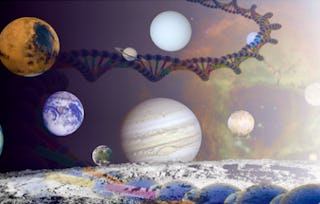
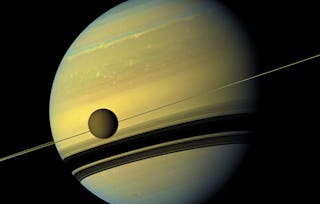
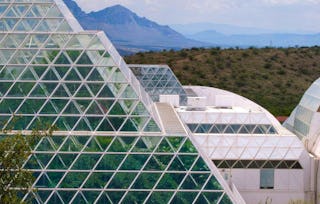
How are astronomers approaching their search for life in the universe? What have we learned from the surge of exoplanets discoveries? How likely is it that Earth does not host the only life in the Universe? In this course we explore the field of astrobiology, an emerging multidisciplinary field. Progress in astrobiology is driven by telescopes on the ground and in space, and by new insights on how life emerged on Earth and its diversity. The topics in this course range from the science of how exoplanets are detected, to the chemistry that supports the argument that the ingredients for life are common in the Universe.
We will follow the analyses of experts in chemistry, astronomy, geology and archaeology to build a strong foundation of understanding. By the final assignment, students will be equipped with the knowledge necessary to identify what makes a planet habitable, and how likely it is that life exists there. Students will graduate from this course informed about one of the most exciting fields in all of science, and ready to discuss the current exoplanet news stories and discoveries.
Materials for this course were developed by Dr. Chris Impey, Professor of Astronomy, Xana Riabokin, Instructional Designer, and Matthew Wenger, Education Program Manager.
Students will learn about planet formation by examining our own solar system and how these basic principles apply to exoplanets (planets around other stars).
What's included
9 videos1 reading7 assignments
Show info about module content
9 videos•Total 132 minutes
Welcome to Astrobiology: Exploring Other Worlds•3 minutes
Introduction to Week 1 - Planets in the Solar System and Beyond•3 minutes
Exoplanets•22 minutes
Planet Formation•19 minutes
Planets and Moons•16 minutes
Our Solar System•13 minutes
Hot Jupiters and Planet Migration•17 minutes
Water Worlds•19 minutes
Census of Exoplanets in the Milky Way•20 minutes
1 reading•Total 10 minutes
Course Participation and Motivation Survey•10 minutes
7 assignments•Total 75 minutes
Exoplanets•15 minutes
Planet Formation•10 minutes
Planets and Moons•10 minutes
Our Solar System•10 minutes
Hot Jupiters and Planet Migration•10 minutes
Water Worlds•10 minutes
Census of Exoplanets in the Milky Way•10 minutes
Hunting for Exoplanets
Module 2•4 hours to complete
Module details
Students will learn about how astronomers look for planets around other stars, why it is so difficult to find them, and what we can learn about the properties of planets from each detection method.
What's included
7 videos6 assignments1 peer review
Show info about module content
7 videos•Total 76 minutes
Introduction to Week 2 - Hunting for Exoplanets•2 minutes
Students will learn about the biological history of Earth, how life can develop and thrive in extreme conditions, and where else in the universe life might exist.
What's included
8 videos7 assignments
Show info about module content
8 videos•Total 107 minutes
Introduction to Week 4 - Life•1 minute
The Early Earth•17 minutes
The Atmosphere and Oceans•13 minutes
Defining Life•18 minutes
Early Life on Earth•15 minutes
Life at the Extreme•16 minutes
Habitable Moons•16 minutes
The Habitability of Mars•11 minutes
7 assignments•Total 100 minutes
The Early Earth•20 minutes
The Atmosphere and Oceans•10 minutes
Defining Life•20 minutes
Early Life on Earth•15 minutes
Life at the Extreme•10 minutes
Habitable Moons•15 minutes
The Habitability of Mars•10 minutes
Emerging Complex Life and Intelligence
Module 5•4 hours to complete
Module details
Students will learn about the development of complex organisms on Earth and the biological processes that led to species evolving intelligence.
What's included
7 videos6 assignments1 peer review
Show info about module content
7 videos•Total 81 minutes
Introduction to Week 5 - Emerging Complex Life and Intelligence•3 minutes
Students will learn about the possibilities of finding intelligence species on other planets, and the challenges of interplanetary and interspecies communication and exploration.
What's included
9 videos14 assignments1 peer review
Show info about module content
9 videos•Total 105 minutes
Introduction to Module 6 - SETI and Cosmic Companionship•3 minutes
Civilizations & Culture•13 minutes
Scientific Revolution•21 minutes
Interstellar Communication•10 minutes
SETI•16 minutes
The Drake Equation•13 minutes
Interstellar Travel•10 minutes
Life as Computation•14 minutes
Exoplanet Mission Proposal - Overview•7 minutes
14 assignments•Total 155 minutes
Civilizations & Culture•10 minutes
Scientific Revolution•15 minutes
Interstellar Communication•10 minutes
SETI•15 minutes
The Drake Equation•15 minutes
Interstellar Travel•10 minutes
Life as Computation•10 minutes
Exoplanet Candidate Maya-186•10 minutes
Exoplanet Candidate Shishen-4•10 minutes
Exoplanet Candidate Tusi-1250•10 minutes
Exoplanet Candidate Lockyer-2•10 minutes
Exoplanet Candidate Cannon-01•10 minutes
Exoplanet Candidate Rubin-70•10 minutes
Exoplanet Candidate Samos-270•10 minutes
1 peer review•Total 120 minutes
Week 6 Final Project - Exoplanet Mission Proposal•120 minutes
Instructor
Instructor ratings
Instructor ratings
We asked all learners to give feedback on our instructors based on the quality of their teaching style.
The University of Arizona is the state’s land-grant university and a member of the Association of American Universities—made up of just 62 universities in the country. As one of the world’s premier public research universities, the university conducts more than $625 million of research annually. Home to two allopathic medical schools in Tucson and Phoenix, the UA Tech Park, and a member of the Arizona Space Grant Consortium, the university creates an $8.3 billion economic impact for Arizona. U.S. News and World Report placed 14 University of Arizona graduate programs among the top 20 in the nation and it is one of the nation’s top producers of Fulbright Scholars. With its strategic academic and business plan, “Never Settle,” as its guide, the university is producing graduates who are global citizens, engaged leaders, and fulfilled individuals.
"To be able to take courses at my own pace and rhythm has been an amazing experience. I can learn whenever it fits my schedule and mood."
Jennifer J.
Learner since 2020
"I directly applied the concepts and skills I learned from my courses to an exciting new project at work."
Larry W.
Learner since 2021
"When I need courses on topics that my university doesn't offer, Coursera is one of the best places to go."
Chaitanya A.
"Learning isn't just about being better at your job: it's so much more than that. Coursera allows me to learn without limits."
Learner reviews
4.9
525 reviews
5 stars
91.80%
4 stars
6.09%
3 stars
0.57%
2 stars
0.19%
1 star
1.33%
Showing 3 of 525
D
DD
5·
Reviewed on Feb 15, 2021
This course has been an amazing experience. Although I would have loved to have classes just to get to know everyone and the professor, it was an insightful course that I would do all over again!
R
RD
5·
Reviewed on Jun 10, 2020
I have absolutely enjoyed this course throughout. It's given me a lot of knowledge and hats off the Prof. Chris Impey for teaching in such an interesting way.
B
BR
5·
Reviewed on Oct 24, 2022
very informative, halps me understand the scope of how life works notnonly on Earth but perhaps elsewhere in the iniverse as well. Makes me excited anout discoveries to come.
When will I have access to the lectures and assignments?
To access the course materials, assignments and to earn a Certificate, you will need to purchase the Certificate experience when you enroll in a course. You can try a Free Trial instead, or apply for Financial Aid. The course may offer 'Full Course, No Certificate' instead. This option lets you see all course materials, submit required assessments, and get a final grade. This also means that you will not be able to purchase a Certificate experience.
What will I get if I purchase the Certificate?
When you purchase a Certificate you get access to all course materials, including graded assignments. Upon completing the course, your electronic Certificate will be added to your Accomplishments page - from there, you can print your Certificate or add it to your LinkedIn profile.
Is financial aid available?
Yes. In select learning programs, you can apply for financial aid or a scholarship if you can’t afford the enrollment fee. If fin aid or scholarship is available for your learning program selection, you’ll find a link to apply on the description page.